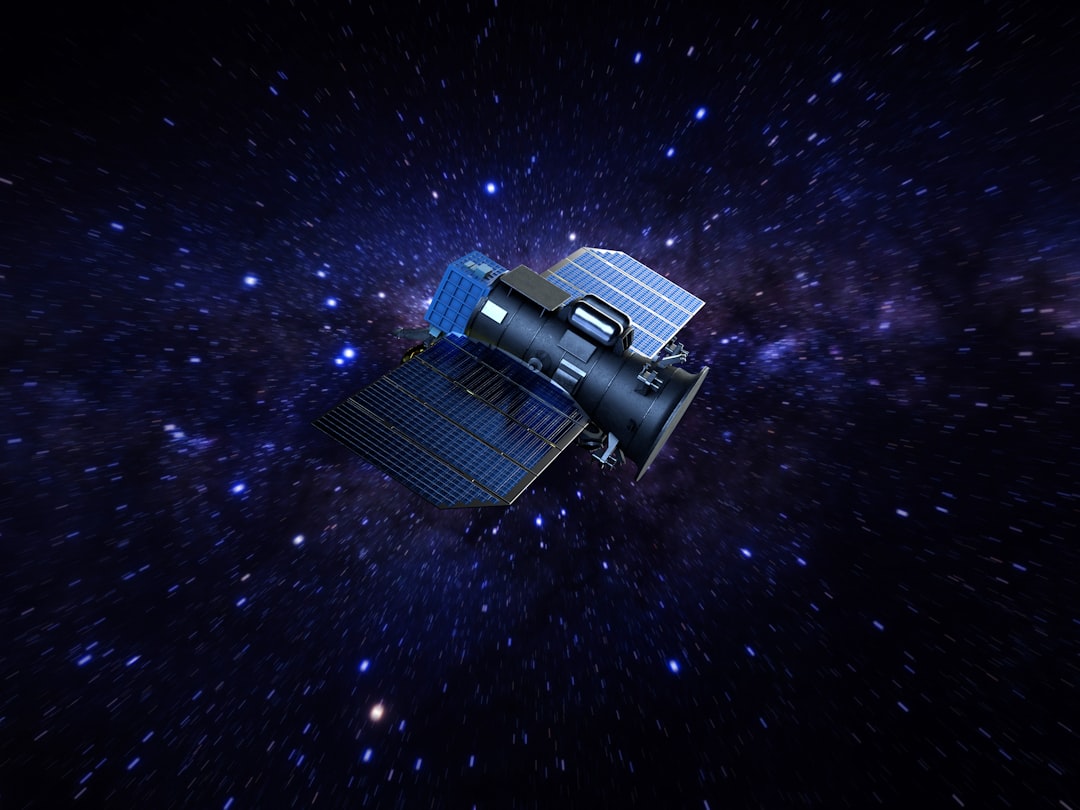
The Black Knight Satellite: A Legacy of Mystery and Observation
For decades, whispers and speculation have swirled around an object in Earth’s orbit, an enigma that has captivated the imaginations of both amateur skywatchers and seasoned space enthusiasts. This object, often referred to as the “Black Knight Satellite,” is not a singular, definitively identified spacecraft in the conventional sense, but rather a collection of observations and persistent anomalous signals that have defied easy explanation. Its purported orbit, closely mirroring a sidereal day – approximately 23 hours and 56 minutes – has lent it a unique status, suggesting a deliberate and persistent presence in the heavens. This article aims to meticulously unpack the history of the Black Knight Satellite, examining the evidence, the theories, and the enduring mystery it represents.
The story of the Black Knight Satellite begins not with a single, definitive sighting, but with a series of fragmented observations and intriguing reports that coalesced over time. The initial seeds of its legend were sown in the mid-20th century, a period of burgeoning space exploration and intense geopolitical competition.
Radio Signals from the Void
One of the earliest and most persistent elements of the Black Knight narrative revolves around unusual radio signals. It is reported that in 1957, amateur radio operators and possibly military installations detected strange, rhythmic radio signals emanating from space. These were not the typical transmissions associated with any known terrestrial broadcasts or early satellites. The signals were described as having a pattern, a pulse that seemed deliberate, leading to speculation that they might originate from an artificial source.
It is crucial to note that concrete, verifiable evidence linking these specific 1957 radio signals directly to a satellite later dubbed “Black Knight” is sparse. However, the very idea of unexplained signals from space served as fertile ground for subsequent interpretations and the development of the Black Knight lore. Imagine these signals as faint footsteps in the cosmic dust, hinting at a presence that could not yet be seen.
The Initial “Sighting”
The term “Black Knight Satellite” itself is attributed to a period somewhat later, though the conceptual groundwork was laid earlier. The idea of a dark, unidentified object in orbit began to gain traction as various space agencies and military bodies were developing capabilities to track objects in space.
Project Argus and Early Space Surveillance
While not directly related to the Black Knight, understanding the context of early space surveillance is important. Projects like Project Argus (a series of high-altitude nuclear tests conducted by the United States in 1958) and the subsequent development of radar and optical tracking systems meant that nations were actively looking for and cataloging objects in Earth’s orbit. This created an environment where anomalies, even if explainable, could be misconstrued.
The “Dark Object” Hypothesis
The notion of a “dark object” gained momentum through various channels, some more credible than others. The lack of reflectivity or a distinctive visual signature may have contributed to it being categorized as “dark.” This absence of data, paradoxically, became a form of evidence for those seeking to identify a mystery object.
The Black Knight Satellite has long been a subject of intrigue and speculation, particularly regarding its unique orbital characteristics, which align closely with a sidereal day of 23 hours and 56 minutes. This fascinating phenomenon raises questions about the satellite’s origins and purpose, prompting enthusiasts and researchers alike to delve deeper into its mysteries. For those interested in exploring more about this enigmatic object, you can read a related article that discusses various theories surrounding the Black Knight Satellite and its implications for our understanding of space. Check it out here: related article.
The Persistent Orbit: The Sidereal Day Connection
The most defining characteristic attributed to the Black Knight Satellite, and perhaps the source of its most enduring fascination, is its purported orbital period. The assertion that it completes an orbit in sync with Earth’s sidereal day, approximately 23 hours, 56 minutes, and 4 seconds, is a cornerstone of the Black Knight legend. This specific duration is not arbitrary; it represents the time it takes for Earth to rotate once with respect to distant stars, as opposed to the solar day which is based on the Sun.
Understanding Sidereal Time
To appreciate the significance of this orbital period, one must understand sidereal time. A solar day is the time it takes for the Sun to appear in the same position in the sky, on average 24 hours. A sidereal day, however, is shorter because as Earth rotates, it also orbits the Sun. Therefore, Earth must rotate a little bit extra each day to “catch up” to the same distant star. This difference is crucial for astronomical observations and celestial navigation.
A Geostationary-like Orbit?
An object in a geostationary orbit (GEO) has an orbital period of precisely one sidereal day. Crucially, however, a true geostationary orbit is situated at an altitude of approximately 35,786 kilometers (22,236 miles) above the Earth’s equator and has an inclination of zero degrees. Objects in true GEO appear stationary in the sky from a fixed point on Earth.
The Black Knight’s purported orbit is often described as closely mirroring this sidereal period, but not necessarily adhering to the strict equatorial inclination of a true geostationary satellite. This distinction is important. If the Black Knight were a celestial body or a natural phenomenon, its orbit would be predictable by physics. If it were an artificial satellite, its orbit would be dictated by its launch parameters and orbital mechanics.
The concept of the Black Knight Satellite has intrigued many, particularly in relation to its unique orbital characteristics, which align closely with a sidereal day of 23 hours and 56 minutes. This fascinating phenomenon has led to numerous theories and discussions about its origins and purpose. For those interested in exploring this topic further, a related article can be found at XFile Findings, where you can delve deeper into the mysteries surrounding the Black Knight Satellite and its implications for our understanding of space.
The Implications of a Sidereal Period
The repeated completion of an orbit in precisely 23 hours and 56 minutes suggests either:
- A highly precise artificial satellite: Designed and launched with extreme accuracy to maintain such an orbit.
- A natural object with an unusual orbital resonance: Though this is less commonly theorized for man-made objects.
- A misinterpretation or fabrication of data: Where the observed period aligns coincidentally or is adjusted to fit the narrative.
The implication of a satellite continuously circling Earth in sync with its rotation, especially one that is purportedly unidentified and potentially ancient, is that it would serve as a constant observer. Imagine a sentinel ceaselessly patrolling the sky, its gaze fixed on our planet.
Unpacking the Evidence: Claims, Counterclaims, and Deconstructions

The Black Knight Satellite has been the subject of numerous claims and analyses, many of which have been debunked or are based on misinterpretations. nevertheless, the persistence of the narrative necessitates a critical examination of the available information.
The 1960 Lunik II Claim
A commonly cited piece of “evidence” involves the Soviet Lunik II probe. In 1959, Lunik II became the first man-made object to impact the Moon. However, some theories suggest that an earlier piece of debris from an early Soviet space program, perhaps related to Lunik II or other early missions, could have been responsible for early “sightings” or signal anomalies.
The idea is that a discarded rocket stage or a component of a failed mission might have been tumbling in orbit, presenting an unusual radar signature. This would explain a dark or non-reflective object and potentially explain some of the early reports of “unidentified” objects.
The “Longest In Orbit” Narrative
A significant part of the Black Knight lore suggests it is an extremely old object, predating modern space programs. Phrases like “the longest in orbit” or “an object that has been orbiting Earth for tens of thousands of years” are frequently associated with it. This is where the speculation often veers into highly improbable territory.
Astronomical Observations and Celestial Records
If such an object had been in orbit for millennia, it would have left a considerable trail in astronomical records. Ancient civilizations meticulously documented celestial movements. The absence of any consistent mention of a dark, erratically moving object that completes an orbit every 23 hours and 56 minutes in any credible ancient text is a substantial point against this claim. The night sky, while vast, is also remarkably predictable in its grand cycles.
The McDonald’s Observatory Connection
In the 1970s, a particularly persistent theory linked the Black Knight Satellite to observational data from the McDonald Observatory in Texas. It was claimed that researchers there had identified an object with unusual characteristics, including its spectral signature and apparent artificiality.
Declassified Documents
FAQs

What is the Black Knight Satellite?
The Black Knight Satellite is a purported object believed by some to be an extraterrestrial satellite orbiting Earth. It has been the subject of various conspiracy theories and speculation, but there is no verified scientific evidence confirming its existence.
What does “sidereal day 23 hours 56 minutes” mean?
A sidereal day is the time it takes for Earth to complete one full rotation relative to distant stars, which is approximately 23 hours and 56 minutes. This is slightly shorter than the solar day of 24 hours, which is based on the Sun’s position.
How is the sidereal day relevant to satellites like the Black Knight?
Satellites orbit Earth based on Earth’s rotation and gravitational forces. The sidereal day is important for understanding orbital mechanics because it defines Earth’s rotation relative to the stars, which affects satellite tracking and positioning.
Is there scientific evidence supporting the existence of the Black Knight Satellite?
No credible scientific evidence supports the existence of the Black Knight Satellite. Most images and signals attributed to it have been explained as space debris, natural phenomena, or man-made objects such as satellites or rocket parts.
Why do some people associate the Black Knight Satellite with a sidereal day?
Some theories suggest that the Black Knight Satellite has an unusual orbit or rotation period related to Earth’s sidereal day of 23 hours and 56 minutes. However, these claims are speculative and not supported by verified data or observations.