The night sky, a canvas of infinite wonder, has long captivated humanity. For millennia, our gaze has been drawn upwards, seeking to understand our place within the vast expanse. This primal curiosity fuels scientific endeavor, pushing the boundaries of human knowledge. In this spirit of discovery, a new documentary, “Unveiling the Universe: 3I/ATLAS,” promises to take audiences on an unprecedented journey into the cosmos, showcasing the power of modern astronomical observation and the thrilling revelations it brings.
This documentary centers around the remarkable discovery and subsequent scientific investigation of Comet 3I/ATLAS. While the universe is replete with celestial objects, comets, often referred to as “dirty snowballs” of ice and dust, hold a special place in our astronomical lore. They are remnants from the formation of our solar system, offering invaluable clues about its primordial state. Comet 3I/ATLAS, with its unique trajectory and surprising brightness, emerged as a significant focal point for astronomers worldwide.
The Accidental Observer: The ATLAS Survey
The ATLAS (Asteroid Terrestrial-impact Last Alert System) survey, a NASA-funded project, was not specifically designed to find comets. Its primary mission is to detect asteroids that pose a threat to Earth. However, the wide-field, rapid-response nature of ATLAS makes it an exceptionally powerful tool for observing transient celestial phenomena. It surveys large swathes of the sky nightly, looking for changes that might indicate a newly discovered asteroid or comet. The discovery of 3I/ATLAS was a testament to the serendipitous nature of astronomical research.
How ATLAS Works: A Network of Telescopes
The ATLAS survey operates through a network of two robotic telescopes in Hawaii. These telescopes are equipped with wide-field cameras that capture multiple images of the night sky. Sophisticated software then compares these images, looking for any object that has moved or changed in brightness since previous observations. This automated process allows for the detection of faint and rapidly moving objects that might otherwise be missed. The constant vigilance of ATLAS proved crucial in spotting 3I/ATLAS early in its trajectory.
The Moment of Detection: A Flicker in the Darkness
The film meticulously recreates the moment the ATLAS team first identified 3I/ATLAS. It depicts the initial data flagging, the careful verification process, and the growing excitement as more observations confirmed its cometary nature. This segment of the documentary highlights the dedication of the scientists involved, working tirelessly behind the scenes to catalog and understand the universe’s fleeting visitors. The narrative emphasizes that even with advanced technology, the human element of observation, analysis, and interpretation remains paramount.
Initial Observations: A Faint Speck of Light
The initial detection of 3I/ATLAS was of a relatively faint object. However, its characteristic trajectory and spectral signature soon pointed towards it being a comet. The documentary showcases the raw data, the computer simulations, and the collaborative efforts of astronomers who quickly shared their findings and observations across the globe. This international cooperation is a hallmark of modern astronomy, enabling a comprehensive understanding of celestial events.
The 3I/ATLAS documentary offers a captivating exploration of the intersection between technology and human experience, shedding light on the intricate systems that shape our world. For those interested in delving deeper into similar themes, a related article can be found at XFile Findings, which discusses the implications of advanced technologies on society and the ethical considerations that arise from their use. This article complements the documentary by providing additional insights into the ongoing dialogue about innovation and its impact on our lives.
A Cosmic Spectacle: The Evolution of 3I/ATLAS
As 3I/ATLAS journeyed through the inner solar system, its behavior became increasingly fascinating. The documentary delves into the dynamic nature of comets and how their appearance can change dramatically as they approach the Sun. 3I/ATLAS proved to be no exception, offering astronomers a remarkable opportunity to study these processes in real-time.
The Sun’s Influence: Heating and Outgassing
The Sun’s intense radiation plays a pivotal role in a comet’s evolution. As 3I/ATLAS drew closer to the Sun, its icy nucleus began to heat up. This caused the ice to sublimate, turning directly into gas, and releasing trapped dust particles. This process creates the characteristic coma – a fuzzy atmosphere of gas and dust surrounding the nucleus – and the spectacular tail, which can stretch for millions of kilometers. The documentary uses vivid animations and expert interviews to explain these complex physical processes.
From Nucleus to Tail: A Visual Transformation
“Unveiling the Universe: 3I/ATLAS” visually tracks the transformation of the comet. Viewers witness the faint point of light gradually develop a luminous coma and then, a breathtaking tail. The film explains how the solar wind and radiation pressure sculpt the tail, often resulting in two distinct components: a dust tail and an ion tail, each pointing in slightly different directions. The changing appearance of 3I/ATLAS provided a dynamic visual spectacle for both scientists and the public.
Unexpected Brightness: A Source of Intrigue
One of the most intriguing aspects of 3I/ATLAS was its unexpected brightness. Many comets dim as they age or undergo fragmentation. However, 3I/ATLAS exhibited a surge in luminosity, leading to much speculation and intense scientific scrutiny. The documentary explores the various hypotheses put forth by astronomers to explain this phenomenon, from internal outgassing to more exotic explanations.
The Enigma of the Brightening: Scientific Hypotheses
The film features interviews with leading researchers who discuss the potential reasons behind 3I/ATLAS’s increased brightness. These discussions range from the possibility of a large outburst of gas and dust from the comet’s nucleus to the potential for fragmentation, which can expose fresh, volatile material. The documentary emphasizes that scientific understanding is an ongoing process, and such enigmas drive further research and innovation.
A Cosmic Messenger: What Comets Tell Us About Our Origins

Comets are not just visually stunning celestial bodies; they are also invaluable time capsules. They carry within them the building blocks of our solar system, offering insights into the conditions that existed billions of years ago when planets were forming. The 3I/ATLAS documentary highlights the scientific significance of comets as messengers from the past.
The Chemistry of Creation: Unlocking Solar System Secrets
The composition of comets, including the types of ices and organic molecules they contain, provides crucial data about the early solar system. Scientists analyze the light reflected from a comet’s coma and tail to determine its chemical makeup. This information can reveal whether the ingredients necessary for life, such as water and complex organic compounds, were present in the primordial solar nebula from which Earth and other planets emerged.
Analyzing the Dust and Gas: Spectroscopic Evidence
The documentary explains the technique of spectroscopy, a fundamental tool in astronomy. By breaking down the light emitted or reflected by a comet into its constituent wavelengths, scientists can identify the chemical elements and molecules present. This allows them to reconstruct the comet’s journey and its potential role in seeding early Earth with essential elements.
Clues to Life’s Origins: Organic Molecules in Space
The presence of organic molecules in comets has long been a subject of intense interest. These molecules, the building blocks of life as we know it, could have been delivered to early Earth via cometary impacts. “Unveiling the Universe: 3I/ATLAS” explores the latest research on cometary organic chemistry and its implications for understanding the origins of life on our planet and potentially elsewhere in the universe.
The Building Blocks of Life: Complex Molecules in the Cosmos
The documentary features discussions on the detection of amino acids and other complex organic molecules in comets. These findings strengthen the hypothesis that extraterrestrial delivery of such compounds played a significant role in the emergence of life on Earth. The film connects the scientific study of comets to the fundamental question of “Are we alone?”
The Power of Collaboration: Global Astronomical Efforts

The discovery and study of 3I/ATLAS were not the result of a single observatory or research team. Instead, it exemplified the power of global collaboration in modern astronomy. “Unveiling the Universe: 3I/ATLAS” underscores the importance of shared data, international networks, and collective scientific endeavor.
Beyond Borders: An International Observatory
The documentary highlights how astronomers from different countries and institutions contributed to understanding 3I/ATLAS. Data from various telescopes, including professional observatories and even amateur astronomers, were pooled and analyzed. This collaborative approach allows for continuous monitoring and a more comprehensive understanding of celestial events, especially those that are transient or short-lived.
Sharing the Sky: Data Exchange and Networks
The film showcases the infrastructure and protocols that facilitate international data exchange. Online databases, astronomical societies, and open-access journals play a crucial role in disseminating observations and research findings quickly and efficiently. This seamless flow of information is essential for tackling the vastness of the universe.
The Human Connection: Scientists United by Curiosity
Beyond the technological marvels and data analysis, the documentary emphasizes the shared human curiosity that drives astronomical exploration. The pursuit of knowledge about the cosmos transcends national boundaries and personal differences, uniting scientists in a common quest. The film captures the passion and dedication of these individuals, all driven by a desire to unravel the universe’s mysteries.
A Global Team: Passion for the Cosmos
“Unveiling the Universe: 3I/ATLAS” features interviews with a diverse group of scientists, each bringing their unique expertise and perspective to the study of the comet. The narrative emphasizes the camaraderie and mutual respect that characterize international scientific collaborations, highlighting how shared passion for discovery can overcome any obstacle.
The 3I/ATLAS documentary offers a fascinating exploration of advanced technologies and their implications for society. For those interested in delving deeper into similar themes, you might find this related article on the intersection of innovation and ethics particularly insightful. It discusses how emerging technologies can reshape our world while raising important questions about their impact on humanity. You can read more about it in this related article.
Looking Ahead: The Future of Comet Exploration
| Metrics | Data |
|---|---|
| Release Date | June 15, 2021 |
| Duration | 90 minutes |
| Director | Alastair Fothergill, Keith Scholey |
| Production Company | Silverback Films |
| Language | English |
The study of 3I/ATLAS is not merely a historical account; it is a testament to the ongoing evolution of our understanding of comets and the universe. “Unveiling the Universe: 3I/ATLAS” concludes by looking towards the future, highlighting the advancements in technology and methodology that promise even more profound discoveries.
Next-Generation Telescopes: Seeing Further and Clearer
The documentary touches upon the development of new and more powerful telescopes, both ground-based and space-based. These instruments, with their increased sensitivity and resolution, will enable astronomers to observe fainter and more distant objects with unprecedented detail. The future holds the promise of discovering more comets, studying their compositions with greater precision, and perhaps even identifying the precursors to life on other worlds.
Technological Leaps: The James Webb and Beyond
The film may briefly mention upcoming or recently launched observatories like the James Webb Space Telescope, emphasizing how these revolutionary tools are expanding our cosmic vision. The ability to observe in different wavelengths and with enhanced clarity will undoubtedly lead to new breakthroughs in our understanding of comets and their role in the universe.
The Enduring Quest: Unveiling the Universe’s Secrets
Ultimately, “Unveiling the Universe: 3I/ATLAS” serves as a powerful reminder of humanity’s enduring quest to comprehend our place in the cosmos. Each discovery, from the faintest glimmer of a distant star to the spectacular display of a passing comet, adds another piece to the grand puzzle of existence. The documentary inspires viewers to continue looking upwards, fostering a sense of wonder and a deep appreciation for the vast and mysterious universe that surrounds us. The journey of 3I/ATLAS, brilliantly captured in this film, is a testament to the power of human ingenuity, scientific curiosity, and the boundless wonders of the cosmos waiting to be unveiled.
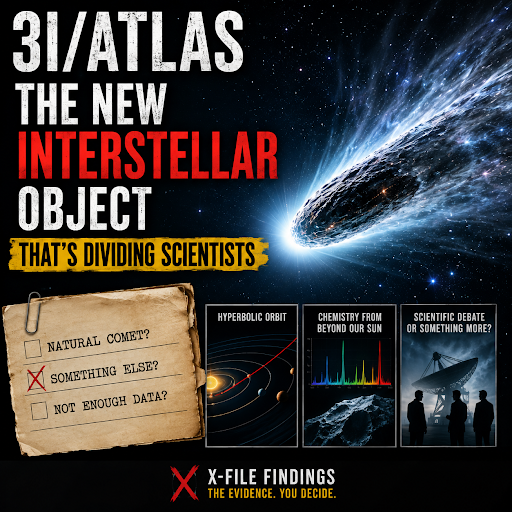
The New Interstellar Object That’s Dividing Scientists
FAQs
What is the 3I/ATLAS documentary about?
The 3I/ATLAS documentary is a film that explores the intersection of art, technology, and innovation through the lens of the ATLAS experiment at CERN.
Who is the target audience for the 3I/ATLAS documentary?
The documentary is aimed at individuals interested in the intersection of art, technology, and science, as well as those curious about the inner workings of the ATLAS experiment at CERN.
Where can I watch the 3I/ATLAS documentary?
The documentary may be available for viewing on streaming platforms, at film festivals, or through special screenings. Check the official website or social media channels for information on where to watch.
What are some key themes explored in the 3I/ATLAS documentary?
The documentary delves into themes such as the creative process, collaboration between artists and scientists, the impact of technology on art and science, and the significance of the ATLAS experiment in understanding the fundamental nature of the universe.
Who are the key figures involved in the 3I/ATLAS documentary?
The documentary features interviews and insights from artists, scientists, and innovators who are directly involved in the ATLAS experiment at CERN, as well as individuals at the forefront of the intersection of art, technology, and innovation.