
The Moon, Earth’s only natural satellite, has long captivated the imagination of scientists and laypeople alike. Among the many intriguing aspects of the Moon is its density, a characteristic that has sparked considerable debate and research within the field of planetary science. The Moon’s average density is approximately 3.34 grams per cubic centimeter, which is significantly lower than that of Earth, which stands at about 5.52 grams per cubic centimeter.
This disparity raises questions about the Moon’s composition and internal structure, leading to various theories regarding its formation and evolution. Understanding the Moon’s density is not merely an academic exercise; it has profound implications for our comprehension of celestial bodies and their origins. The Moon’s relatively low density suggests that it may possess a different internal structure compared to Earth and other terrestrial planets.
This article delves into the significance of density in planetary science, explores how scientists measure it, and examines the theories surrounding the Moon’s hollow interior, ultimately shedding light on the ongoing mystery of this celestial body.
Key Takeaways
- The density of the Moon is much lower than that of Earth, leading to questions about its interior composition.
- Understanding density is crucial in planetary science as it provides insights into the composition and formation of celestial bodies.
- Scientists measure the density of celestial bodies using various methods, including gravitational field measurements and seismic data.
- The surprisingly low density of the Moon has led to theories about its hollow interior, sparking debate among researchers.
- Evidence supporting the idea of a hollow Moon includes anomalies in its gravitational field and seismic data from moonquakes.
Understanding Density and Its Importance in Planetary Science
Density, defined as mass per unit volume, serves as a fundamental property in the study of planetary bodies. It provides critical insights into the composition and internal structure of planets and moons. In planetary science, density can reveal whether a celestial body is composed primarily of metals, silicates, or ices, which in turn informs scientists about its formation history and geological processes.
The importance of density extends beyond mere classification; it also plays a crucial role in understanding gravitational interactions between celestial bodies. The gravitational pull of a planet or moon is influenced by its mass and density, affecting everything from orbital dynamics to tidal forces.
As such, studying density is essential for comprehending not only the Moon but also other celestial bodies within our solar system and beyond.
How Scientists Measure the Density of Celestial Bodies
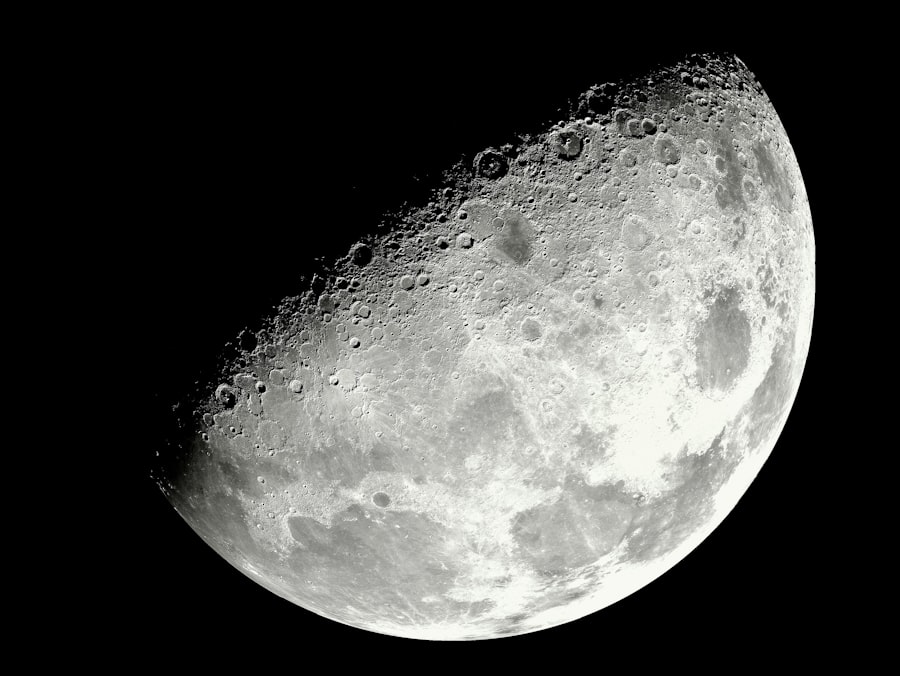
Scientists employ various methods to measure the density of celestial bodies, each tailored to the unique characteristics of the object in question. One common approach involves calculating density through gravitational measurements. By observing the gravitational pull exerted by a celestial body on nearby spacecraft or satellites, scientists can infer its mass.
Once mass is determined, they can divide it by the volume of the body—often estimated through imaging techniques or radar measurements—to arrive at an accurate density value. Another method involves analyzing samples returned from celestial bodies, such as lunar rocks brought back by the Apollo missions. By measuring the mass of these samples in a laboratory setting and determining their volume through techniques like water displacement, researchers can calculate their density directly.
This hands-on approach provides valuable data that can be compared with remote sensing measurements, allowing for a more comprehensive understanding of the Moon’s overall density.
The Surprising Low Density of the Moon
| Aspect | Measurement |
|---|---|
| Mean density of the Moon | 3.34 g/cm³ |
| Comparison to Earth’s density | Approximately 3.3 times less dense |
| Reason for low density | Lack of heavy metals and large core |
The Moon’s average density of 3.34 grams per cubic centimeter is indeed surprising when compared to Earth’s denser composition. This lower density suggests that the Moon may have a different internal structure than previously thought. While Earth is believed to have a metallic core surrounded by a silicate mantle and crust, the Moon’s composition raises questions about its own internal layering.
The lower density indicates that the Moon may contain a higher proportion of lighter materials or be less compact than Earth. This unexpected finding has led scientists to explore various hypotheses regarding the Moon’s formation. One prominent theory posits that the Moon was formed from debris resulting from a colossal impact between Earth and a Mars-sized body early in the solar system’s history.
If this were true, one might expect the Moon to share more similarities with Earth’s composition.
Theories about the Moon’s Hollow Interior
The notion of a hollow Moon has intrigued both scientists and conspiracy theorists alike. Some researchers have proposed that the Moon may possess a hollow interior based on its low density and certain seismic data collected during lunar missions. This theory suggests that rather than being solid throughout, the Moon could contain vast empty spaces or cavities within its structure.
Proponents of this theory argue that if the Moon were hollow, it could explain some of its unusual characteristics, such as its low density and certain gravitational anomalies observed during lunar missions. While this idea may seem far-fetched to some, it has sparked discussions about alternative models for understanding lunar geology and internal structure.
Evidence Supporting the Idea of a Hollow Moon
While mainstream science generally does not support the idea of a hollow Moon, there are intriguing pieces of evidence that have fueled speculation on this topic. One such piece of evidence comes from seismic data collected by seismometers placed on the lunar surface during the Apollo missions. These instruments recorded moonquakes and provided insights into how seismic waves traveled through the Moon’s interior.
Some researchers have noted that certain seismic waves appeared to behave differently than expected when passing through specific regions of the Moon, leading to hypotheses about potential voids or less dense areas within its structure. Additionally, observations of gravitational anomalies—areas where gravity appears weaker than expected—have also been cited as possible indicators of a hollow interior. However, these interpretations remain contentious within the scientific community.
The Relationship Between the Moon’s Density and Its Formation
The relationship between the Moon’s density and its formation is a complex puzzle that continues to challenge scientists. The prevailing theory suggests that the Moon formed from debris ejected into space after a massive impact with Earth. This event would have resulted in a mixture of materials from both bodies being incorporated into the Moon’s structure.
However, if this theory holds true, one would expect the Moon to share more similarities with Earth’s composition, particularly in terms of density. The fact that it is less dense raises questions about how much material from Earth actually contributed to its formation and whether other processes influenced its development over time. Understanding this relationship is crucial for piecing together not only the history of the Moon but also that of Earth and other celestial bodies in our solar system.
The Implications of a Hollow Moon for Lunar Exploration
If further research were to substantiate claims regarding a hollow Moon, it would have significant implications for future lunar exploration missions. A hollow interior could suggest vast caverns or voids that might be explored for scientific purposes or even potential habitation sites for future human missions. Such discoveries could revolutionize our understanding of lunar geology and open new avenues for exploration.
Moreover, if there are indeed large empty spaces within the Moon, they could potentially harbor unique geological features or even ancient remnants from its formation period. This would provide invaluable insights into not only lunar history but also broader planetary formation processes across our solar system.
Debunking Myths and Misconceptions about the Moon’s Density
Despite ongoing discussions about the Moon’s density and potential hollowness, many myths and misconceptions persist in popular culture. One common myth is that the Moon is entirely hollow or artificial—a notion often perpetuated by conspiracy theories without scientific backing. In reality, while there are intriguing questions surrounding its internal structure, there is no credible evidence to support claims that it is hollow or constructed by extraterrestrial beings.
Additionally, some misconceptions arise from misunderstandings about how density relates to geological processes. For instance, while lower density might suggest less compact material, it does not necessarily imply that a celestial body lacks geological complexity or history. The Moon has undergone significant geological changes over billions of years, resulting in its current state—one that continues to be studied and understood through ongoing research.
Future Research and Missions to Further Study the Moon’s Interior
As interest in lunar exploration continues to grow, future missions are poised to provide deeper insights into the Moon’s interior structure and density. NASA’s Artemis program aims to return humans to the lunar surface by 2024 and establish a sustainable presence on the Moon by 2028. These missions will not only focus on surface exploration but also include scientific investigations aimed at understanding lunar geology more comprehensively.
In addition to crewed missions, robotic landers and orbiters equipped with advanced instruments will play crucial roles in gathering data about the Moon’s internal structure. By employing techniques such as gravity mapping and seismic monitoring, scientists hope to unravel some of the mysteries surrounding its density and potential hollowness.
The Ongoing Mystery of the Moon’s Density and Hollow Interior
The mystery surrounding the Moon’s density and potential hollow interior remains an intriguing topic within planetary science. While current evidence does not conclusively support theories of a hollow Moon, ongoing research continues to challenge existing paradigms and deepen our understanding of this celestial body. As new missions are launched and technology advances, scientists are optimistic about uncovering more secrets hidden beneath the lunar surface.
Ultimately, whether or not the Moon possesses a hollow interior may be less important than what these inquiries reveal about our solar system’s history and formation processes. The quest for knowledge about our nearest neighbor will undoubtedly continue to inspire generations of scientists and explorers alike as they seek answers to one of humanity’s oldest questions: what lies beyond our world?
In recent discussions about the Moon’s density and the intriguing hypothesis of its potential hollowness, various theories have emerged that challenge conventional understanding. One such theory suggests that the Moon might not be as solid as previously thought, raising questions about its formation and structure. For those interested in exploring this topic further, a related article can be found on the X File Findings website. This article delves into the scientific and speculative aspects of the Moon’s composition, providing a comprehensive overview of current research and theories. You can read more about it by visiting this page.
WATCH THIS 🌙 The Moon’s Soul Trap: John Lear’s Chilling Revelation
FAQs
What is the density of the Moon?
The average density of the Moon is about 3.34 grams per cubic centimeter, which is roughly 60% of the density of Earth.
How is the density of the Moon determined?
The density of the Moon is determined by measuring its mass and volume. The mass is calculated using the gravitational pull on spacecraft orbiting the Moon, and the volume is estimated based on its size and shape.
Is the Moon hollow?
There is no scientific evidence to support the claim that the Moon is hollow. The current understanding is that the Moon has a solid, rocky interior, similar to Earth.
What are some theories about the hollowness of the Moon?
Some theories about the hollowness of the Moon include the idea that it is an artificial satellite or that it contains large, hollow caverns. However, these theories are not supported by scientific evidence.
What are the implications of the Moon’s density and hollowness?
Understanding the density and structure of the Moon can provide valuable insights into its formation and evolution. It can also help scientists better understand the processes that shaped the Moon and its relationship to other celestial bodies.