The concept of toroidal lattice nested geometry represents a fascinating and complex area within mathematical and scientific inquiry. It describes structures composed of multiple nested tori, often arranged in a lattice formation, exhibiting both macroscopic regularity and intricate microscopic detail. This field draws upon principles from topology, geometry, and graph theory, finding applications in diverse areas ranging from theoretical physics to material science and computer graphics. Understanding these geometries requires a deliberate unpacking of their fundamental components and the principles governing their interaction.
Tori, at their most basic, are surfaces of revolution formed by rotating a circle in three-dimensional space about an axis coplanar with the circle but not intersecting it. This process creates the familiar donut shape. However, in the context of toroidal lattice nested geometry, the definition extends beyond simple, solid tori to encompass abstract topological spaces and their embeddings. Explore the mysteries of the Antarctic gate in this fascinating video.
Defining the Torus
A standard torus, often denoted as $T^2$, is topologically equivalent to the Cartesian product of two circles, $S^1 \times S^1$. This intrinsic definition is crucial for understanding its properties, such as its genus (number of “holes”), which for a standard torus is one. From a geometric perspective, a torus can be parameterized by two angles, $\theta$ and $\phi$, representing the rotation along the major and minor radii, respectively.
Varieties of Toroidal Forms
While the standard ring torus is the most recognized, other toroidal forms exist. A spindle torus, for instance, is formed when the axis of revolution intersects the circle, creating a shape with a pointed inner cusp. A horn torus arises when the axis of revolution is tangent to the circle, resulting in a torus with no “hole” in the traditional sense, but rather a single point of self-intersection. These variations highlight the geometric flexibility of toroidal structures, and their properties can influence the overall characteristics of nested systems.
Topological Considerations
Topology plays a vital role in understanding toroidal lattices. The connectivity and orientability of a torus, for example, are inherent properties that remain invariant under continuous deformation. When tori are nested or interconnected, their individual topological properties combine to create a complex global topology. Researchers often employ homology and cohomology groups to characterize these complex spaces, providing a robust mathematical framework for their analysis.
In exploring the fascinating concepts of toroidal lattice nested geometry, one can find valuable insights in the article available at XFile Findings. This resource delves into the intricate relationships between geometric structures and their applications in various fields, shedding light on how toroidal configurations can influence both theoretical and practical aspects of geometry. By examining these connections, researchers can better understand the underlying principles that govern complex systems and their behaviors.
Principles of Nesting and Lattices
The true complexity of these geometries emerges when multiple tori are arranged in a nested, often periodic, fashion. This nesting can occur along various axes and at multiple scales, leading to hierarchical structures with emergent properties.
Hierarchical Arrangement
Nesting implies a containment relationship, where one torus or a group of tori is entirely enclosed within another larger torus. This can be visualized as Russian dolls, but composed of toroidal shapes. The hierarchy can extend to several levels, with smaller tori forming the “walls” or “fibers” of larger, encompassing tori. The ratio of radii between nested layers, the number of nested layers, and the spatial distribution of these layers are critical parameters in defining the overall structure. Consider, for example, a series of tori where the minor radius of an outer torus is effectively defined by the major radius of the inner torus. This creates a cascade of self-similar, or near self-similar, structures.
Lattice Formation
Beyond simple nesting, the integration of tori into a lattice introduces periodicity and translational symmetry. Imagine an infinite array of these nested toroidal units, repeating in one, two, or three dimensions. This transforms the localized nested structure into a global, extended system. The lattice can be simple cubic, face-centered cubic, hexagonal, or any other crystallographic arrangement. The type of lattice dictates the packing density, the connectivity between neighboring toroidal units, and the overall anisotropic properties of the material or system being modeled. The nature of the connections between these toroidal units – whether they are direct physical connections, shared boundaries, or simply spatial proximity – significantly impacts the system’s behavior.
Interconnectivity and Gaps
A crucial aspect of toroidal lattice nested geometry is the interplay between the solids (the tori themselves) and the voids or channels between them. These spaces are not merely empty; they form intricate networks that can facilitate transport, provide structural pathways, or define specific functional zones. The size, shape, and connectivity of these interstitial spaces are highly dependent on the radii of the nested tori, their relative positioning, and the chosen lattice parameters. Understanding these interconnections is paramount for applications in areas like filtration membranes or photonic crystals, where the flow of substances or energy relies on these intricate pathways.
Mathematical Representation and Modeling
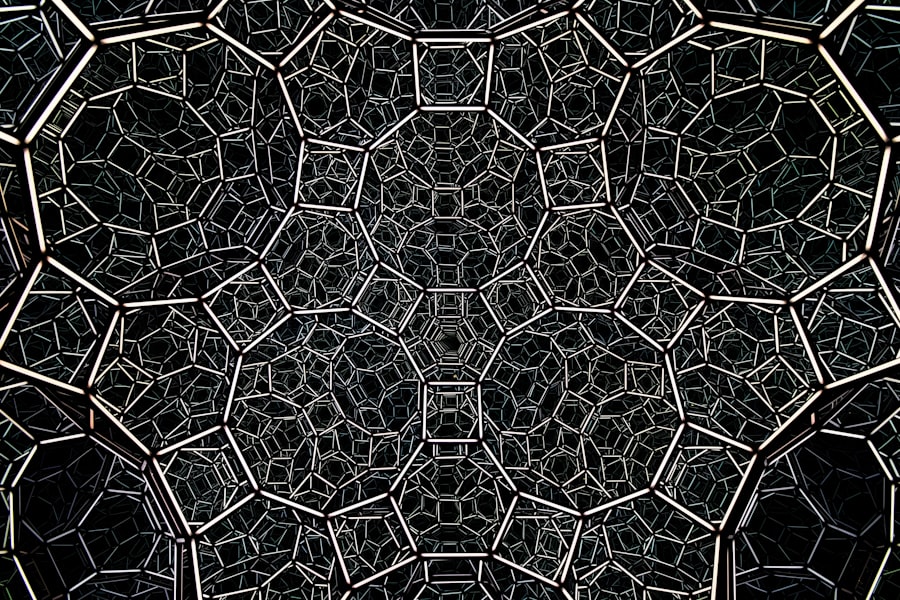
Modeling toroidal lattice nested geometries presents significant mathematical challenges due to their inherent complexity and multi-scale nature. Researchers employ a variety of computational and analytical tools to characterize, visualize, and simulate these structures.
Parametric Equations
For individual tori, parametric equations offer a precise way to describe their surfaces and volumes. For a standard torus, parameterization is typically:
$x = (R + r \cos \phi) \cos \theta$
$y = (R + r \cos \phi) \sin \theta$
$z = r \sin \phi$
where $R$ is the major radius and $r$ is the minor radius. Extending this to nested tori involves introducing multiple sets of $R$ and $r$ values, along with transformations (translations and rotations) for each nested layer. For lattice arrangements, these individual parametric descriptions are then combined and replicated according to the lattice vectors.
Implicit Surfaces and Level Set Methods
Implicit surface definitions, such as those derived from algebraic equations, provide an alternative approach, particularly useful when dealing with complex boolean operations (unions, intersections, differences) between toroidal shapes. Level set methods, which represent surfaces as the zero level set of a higher-dimensional function, offer even greater flexibility for modeling dynamic changes in geometry or for handling structures with complex interconnections and variable thicknesses. These methods can elegantly describe both the solid tori and the void spaces, enabling the study of diffusion or fluid flow.
Computational Geometry and Visualization
Specialized algorithms from computational geometry are essential for generating and manipulating digital models of these structures. Techniques like constructive solid geometry (CSG) allow for the creation of complex shapes by combining simpler primitives (like cylinders, spheres, and tori) using Boolean operations. Advanced visualization software is crucial for rendering these intricate geometries, enabling researchers to explore their three-dimensional characteristics and identify emergent patterns that might otherwise be overlooked in purely numerical data.
Applications and Potential
The theoretical exploration of toroidal lattice nested geometry is not an abstract exercise; it holds significant promise across a spectrum of scientific and engineering disciplines. Its ability to create finely tuned, hierarchical structures makes it attractive for designing materials with specific functional properties.
Metamaterials and Photonics
One prominent area of application is in the design of metamaterials. These are engineered materials with properties that are not found in naturally occurring substances, often due to their microstructural design. Toroidal lattice nested geometries can be engineered to exhibit exotic electromagnetic properties, including negative refractive index, by carefully controlling the sizes, shapes, and arrangements of the nested toroidal units. Similarly, in photonics, these structures can be used to create photonic crystals that control the flow of light, leading to novel optical devices and greatly enhanced light-matter interactions. The intricate network of voids and solids acts as a waveguide, dictating which frequencies of light can pass and how they propagate.
Catalysis and Filtration
The high surface area and interconnected pore networks inherent in these geometries make them excellent candidates for advanced catalysts and filtration membranes. Imagine a catalyst where reactants flow through a tortuous path defined by nested toroidal channels, maximizing contact with catalytic surfaces. In filtration, the precisely controlled pore sizes and tortuosity could enable highly selective separation of molecules, outperforming conventional membranes. The ability to tailor the size scales of the nested tori allows for fine-tuning of molecular sieving capabilities, potentially opening doors for more efficient chemical processes and purification technologies.
Biomedical Engineering
In biomedical engineering, the potential for drug delivery systems and tissue scaffolding is significant. Nested toroidal structures could be designed to encapsulate and release therapeutic agents at controlled rates, with the various layers acting as a timed-release mechanism. For tissue engineering, porous scaffolds with biologically inspired geometries are crucial for cell adhesion, nutrient transport, and tissue regeneration. The robust and interconnected architecture of toroidal lattice nested geometries could provide the structural integrity and conducive microenvironment needed for growing complex biological tissues. Consider, for instance, a scaffold designed to mimic the hierarchical porosity of bone, facilitating ingrowth.
Data Storage and Quantum Computing
On a more speculative frontier, researchers are exploring the potential of these geometries in novel data storage paradigms and even quantum computing. The intricate topological configurations could offer new ways to encode and protect information. Topological qubits, which leverage the robust properties of topological spaces, might find unique implementations within these nested toroidal structures, potentially offering greater resilience against quantum decoherence – the bane of current quantum computing efforts. The underlying principles of localized and delocalized states within such complex geometries could unlock unforeseen computational advantages.
Toroidal lattice nested geometry is a fascinating topic that explores the intricate relationships between geometric structures and their applications in various fields. For those interested in delving deeper into this subject, a related article can be found at this link, which discusses the implications of such geometries in modern science and technology. The interplay between mathematical theory and practical applications is particularly intriguing, making it a valuable read for enthusiasts and professionals alike.
Challenges and Future Directions
| Metric | Description | Typical Value | Unit |
|---|---|---|---|
| Major Radius (R) | Distance from the center of the torus to the center of the tube | 10 | units |
| Minor Radius (r) | Radius of the tube forming the torus | 3 | units |
| Lattice Constant (a) | Distance between adjacent lattice points in the nested geometry | 1.5 | units |
| Number of Nested Layers | Count of concentric lattice layers within the toroidal structure | 5 | layers |
| Coordination Number | Number of nearest neighbors for each lattice point | 6 | neighbors |
| Symmetry Group | Mathematical group describing the symmetry of the lattice | Dn (dihedral) | — |
| Curvature | Gaussian curvature of the toroidal surface | Variable (negative on inner, positive on outer) | 1/units² |
| Volume | Volume enclosed by the toroidal lattice | ~565 | units³ |
Despite the considerable promise, the field of toroidal lattice nested geometry is not without its challenges. Overcoming these hurdles will be crucial for transitioning theoretical concepts into practical applications.
Fabrication Limitations
A primary challenge lies in the fabrication of these highly intricate, multi-scale structures. Achieving precise control over the nesting dimensions and lattice parameters, particularly at the nanoscale, requires advanced manufacturing techniques. Current methods, such as 3D printing, two-photon lithography, and self-assembly, are continuously evolving, but scaling up production and ensuring material integrity remain significant hurdles. The precision required for many of the proposed applications demands manufacturing capabilities that push the boundaries of current technology.
Characterization and Measurement
Once fabricated, characterizing the actual internal structure of nested toroidal lattices presents its own set of difficulties. Non-destructive techniques capable of resolving features across multiple scales, from nanometers to millimeters, are essential for verifying the design and understanding the true properties of the materials. Advanced imaging techniques, such as X-ray computed tomography (CT) with high spatial resolution, electron microscopy, and atomic force microscopy, are vital tools for this purpose, but their application to deeply nested, complex structures is still an area of active research.
Multi-physics Modeling
Simulating the behavior of these geometries under various external stimuli (e.g., electromagnetic fields, fluid flow, mechanical stress) requires sophisticated multi-physics modeling. The interplay between different physical phenomena within these complex, hierarchical structures can be challenging to capture accurately. Developing robust numerical methods and computational resources capable of handling the vast number of degrees of freedom inherent in these multi-scale systems is an ongoing endeavor.
Theoretical Advancements
From a theoretical perspective, there is still much to explore. Devising new topological invariants that can effectively characterize the complexity of nested toroidal lattices, and developing analytical solutions for their emergent properties, are key areas for future research. Understanding the relationship between their geometric parameters, topological properties, and functional performance in a more comprehensive mathematical framework will be critical for rational design and optimization. The journey into unlocking the full potential of toroidal lattice nested geometry is ongoing, promising both profound scientific insights and transformative technological breakthroughs.
FAQs
What is a toroidal lattice?
A toroidal lattice is a type of geometric structure arranged on the surface of a torus, which is a doughnut-shaped figure. It consists of points or nodes connected in a repeating pattern that wraps around both the major and minor circumferences of the torus.
What does “nested geometry” mean in the context of toroidal lattices?
Nested geometry refers to a configuration where multiple geometric structures are embedded or arranged within each other in a hierarchical manner. In toroidal lattices, this can mean smaller lattices or patterns are contained within larger ones, creating complex, multi-scale arrangements.
Where are toroidal lattice nested geometries used?
Toroidal lattice nested geometries are used in various fields including physics, materials science, and mathematics. They are important in studying topological properties, designing advanced materials, and modeling complex systems such as magnetic confinement in fusion reactors or network topologies.
How is a toroidal lattice different from a regular lattice?
A regular lattice is typically defined in flat, Euclidean space with repeating units extending infinitely in one or more directions. A toroidal lattice, however, is defined on the surface of a torus, meaning it has periodic boundary conditions in two directions, creating a closed, curved surface without edges.
What are the mathematical properties of toroidal lattices?
Toroidal lattices exhibit periodicity in two independent directions and can be described using modular arithmetic or topology. They often involve concepts from algebraic topology, such as homology and fundamental groups, to characterize their structure and symmetries.
Can toroidal lattice nested geometries be visualized?
Yes, toroidal lattice nested geometries can be visualized using computer graphics and mathematical modeling software. Visualizations often depict the torus surface with interconnected nodes and edges, highlighting the nested patterns and repeating units.
What challenges exist in studying toroidal lattice nested geometries?
Challenges include the complexity of accurately modeling the curved surface and nested structures, computational difficulties in simulating large or highly nested lattices, and understanding the physical implications of these geometries in real-world applications.
Are toroidal lattice nested geometries related to any physical phenomena?
Yes, they are related to phenomena such as magnetic confinement in plasma physics, crystal structures in materials science, and certain types of wave propagation. Their topology can influence physical properties like conductivity, stability, and resonance.