
GPS Disciplined Oscillators (GPSDOs) are sophisticated devices that utilize signals from Global Positioning System (GPS) satellites to maintain precise frequency standards. The calibration of these oscillators is crucial for a variety of applications, including telecommunications, scientific research, and navigation systems. At its core, GPSDO frequency calibration involves aligning the output frequency of the oscillator with the highly accurate time signals received from GPS satellites.
This process ensures that the oscillator operates within specified tolerances, providing reliable and consistent frequency outputs. The calibration process typically involves comparing the oscillator’s output against a known reference frequency derived from GPS signals. This comparison allows for adjustments to be made, ensuring that the oscillator remains synchronized with the universal time standard.
The precision of this calibration is paramount, as even minute discrepancies can lead to significant errors in applications that rely on accurate timing and frequency. Understanding the intricacies of GPSDO frequency calibration is essential for engineers and technicians who work with these devices, as it directly impacts the performance and reliability of various systems.
Key Takeaways
- GPSDO frequency calibration is essential for achieving highly precise and stable timing signals.
- Precision in frequency calibration directly impacts the accuracy and reliability of GPS-based systems.
- Environmental factors and hardware limitations can affect the accuracy of GPSDO frequency calibration.
- Advanced techniques and specialized tools are used to optimize and maintain GPSDO frequency calibration.
- Ongoing developments aim to enhance the precision and robustness of GPSDO frequency calibration for future applications.
The Importance of Precision in Frequency Calibration
Precision in frequency calibration is not merely a technical requirement; it is a fundamental necessity in many fields. In telecommunications, for instance, accurate frequency calibration ensures that signals are transmitted and received without interference or distortion. This precision is vital for maintaining the integrity of data transmission, which can affect everything from mobile communications to internet connectivity.
In scientific research, particularly in fields such as physics and astronomy, even the slightest deviation in frequency can lead to erroneous results or misinterpretations of data. Moreover, industries such as aerospace and defense rely heavily on precise frequency calibration for navigation and guidance systems. In these sectors, the consequences of inaccurate frequency measurements can be dire, potentially leading to catastrophic failures or safety hazards.
Therefore, the importance of precision in frequency calibration cannot be overstated; it serves as the backbone of reliable technology and systems that society depends on daily.
Factors Affecting GPSDO Frequency Calibration
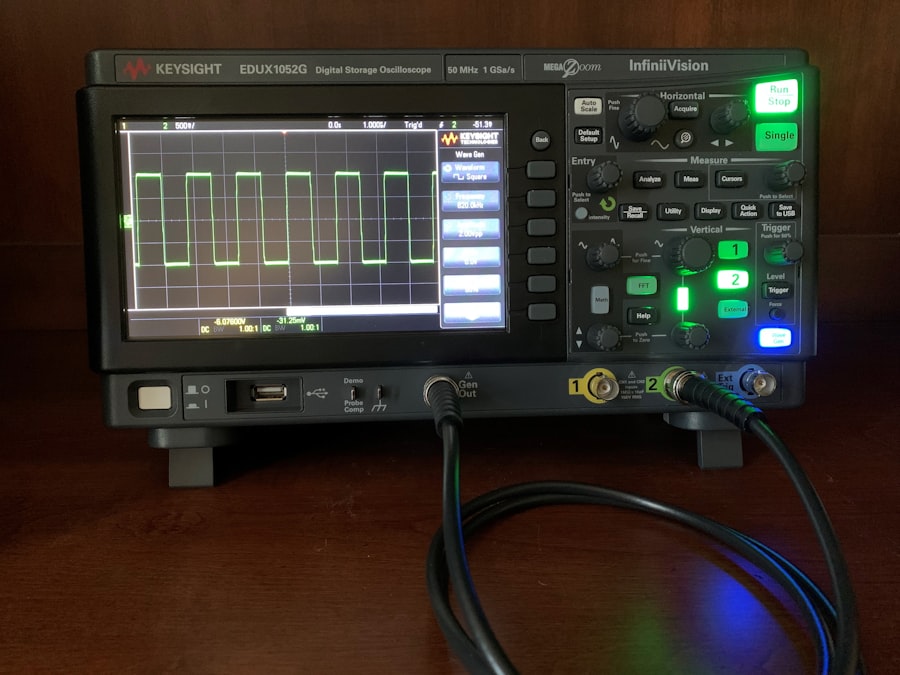
Several factors can influence the accuracy and reliability of GPSDO frequency calibration. Environmental conditions play a significant role; temperature fluctuations, humidity levels, and atmospheric pressure can all affect the performance of oscillators. For instance, temperature changes can lead to frequency drift, causing the oscillator to deviate from its calibrated state.
Additionally, electromagnetic interference from nearby electronic devices can introduce noise into the system, further complicating the calibration process. Another critical factor is the quality of the GPS signal itself. The accuracy of GPSDO frequency calibration is contingent upon receiving strong and stable signals from multiple satellites.
Obstructions such as buildings or natural terrain can block or reflect these signals, leading to inaccuracies in timing and frequency measurements. Furthermore, the design and quality of the GPSDO hardware also play a crucial role; components such as oscillators, filters, and amplifiers must be of high quality to ensure optimal performance during calibration.
Techniques for Optimizing GPSDO Frequency Calibration
To achieve optimal GPSDO frequency calibration, several techniques can be employed. One effective method is to utilize multiple GPS satellites for signal reception. By receiving signals from several satellites simultaneously, the system can average out any discrepancies caused by signal interference or multipath effects.
This approach enhances the reliability of the timing information used for calibration, resulting in more accurate frequency outputs. Another technique involves implementing temperature compensation mechanisms within the GPSDO. By monitoring temperature variations and adjusting the oscillator’s output accordingly, it is possible to minimize frequency drift caused by environmental changes.
Additionally, using high-quality components and advanced filtering techniques can help reduce noise and improve overall system performance. Regular maintenance and recalibration are also essential practices that ensure long-term accuracy and reliability in GPSDO frequency calibration.
The Role of GPS in Frequency Calibration
| Parameter | Description | Typical Value | Unit | Notes |
|---|---|---|---|---|
| Frequency Stability | Short-term frequency stability (Allan Deviation) | 1 x 10-12 | τ = 1 s | Depends on oscillator quality and GPS disciplining |
| Frequency Accuracy | Long-term frequency accuracy after calibration | ±5 x 10-12 | Hz/Hz | Typical for well-calibrated GPSDO units |
| Phase Noise | Phase noise at 1 Hz offset | -120 | dBc/Hz | Depends on oscillator and GPSDO design |
| Output Frequency | Nominal output frequency | 10 | MHz | Standard frequency for GPSDO output |
| Holdover Stability | Frequency stability during GPS signal loss | 1 x 10⁻⁹ | Over 1 hour | Depends on oscillator quality |
| Calibration Interval | Recommended recalibration period | 12 | Months | Ensures long-term accuracy |
| Temperature Coefficient | Frequency change per degree Celsius | ±5 x 10⁻¹⁰ | per °C | Depends on oscillator type (OCXO, TCXO) |
The Global Positioning System plays a pivotal role in modern frequency calibration processes. By providing highly accurate time signals derived from atomic clocks onboard satellites, GPS enables GPSDOs to maintain synchronization with universal time standards. This synchronization is crucial for various applications that require precise timing, such as financial transactions, scientific experiments, and global navigation systems.
Moreover, GPS technology has evolved significantly over the years, enhancing its reliability and accuracy. The introduction of additional satellite constellations and improved signal processing techniques has further bolstered the role of GPS in frequency calibration. As a result, GPSDOs can now achieve unprecedented levels of precision, making them indispensable tools in a wide range of industries.
Benefits of GPSDO Frequency Calibration
The benefits of GPSDO frequency calibration are manifold and extend across various sectors. One of the most significant advantages is enhanced accuracy in timing and frequency measurements. With precise calibration, systems can operate with minimal errors, leading to improved performance in telecommunications, navigation, and scientific research.
This accuracy translates into better data integrity and reliability, which are critical for decision-making processes in many fields. Additionally, GPSDO frequency calibration contributes to cost savings by reducing the need for frequent maintenance or recalibration. Systems that operate with high precision tend to experience fewer errors and malfunctions, leading to lower operational costs over time.
Furthermore, the ability to maintain synchronization with universal time standards allows organizations to streamline their operations and improve overall efficiency.
Challenges in GPSDO Frequency Calibration
Despite its numerous advantages, GPSDO frequency calibration is not without challenges. One significant hurdle is the dependency on external factors such as satellite visibility and signal quality.
Additionally, adverse weather conditions can affect signal reception, further complicating the calibration process. Another challenge lies in the inherent limitations of the hardware used in GPSDOs. While advancements have been made in technology, some components may still be susceptible to aging or environmental influences that can impact their performance over time.
This necessitates regular monitoring and maintenance to ensure that the system remains calibrated accurately. Addressing these challenges requires ongoing research and development efforts to enhance both hardware and software solutions for GPSDO frequency calibration.
Best Practices for GPSDO Frequency Calibration
Implementing best practices for GPSDO frequency calibration is essential for achieving optimal performance and reliability. One key practice is to establish a routine maintenance schedule that includes regular checks on signal quality and system performance. By monitoring these parameters consistently, technicians can identify potential issues before they escalate into significant problems.
Another best practice involves utilizing advanced software tools for data analysis and visualization during the calibration process. These tools can help technicians identify trends or anomalies in frequency measurements, allowing for timely adjustments to be made. Additionally, training personnel on the latest techniques and technologies related to GPSDO frequency calibration ensures that organizations remain at the forefront of industry standards.
Tools and Equipment for GPSDO Frequency Calibration
A variety of tools and equipment are available to facilitate effective GPSDO frequency calibration. High-precision oscillators are essential components that serve as references during the calibration process. These oscillators must be capable of maintaining stability over extended periods while minimizing drift caused by environmental factors.
Signal analyzers are another critical tool used in frequency calibration. These devices allow technicians to assess signal quality and identify any interference or noise that may affect measurements. Additionally, software solutions designed for data logging and analysis play a vital role in optimizing calibration processes by providing insights into system performance over time.
Future Developments in GPSDO Frequency Calibration
The future of GPSDO frequency calibration holds exciting possibilities as technology continues to advance. Innovations in satellite technology may lead to improved signal accuracy and reliability, further enhancing the capabilities of GPSDOs. Additionally, developments in quantum computing could revolutionize how frequency standards are established and maintained, potentially leading to unprecedented levels of precision.
Furthermore, ongoing research into alternative positioning systems may complement or enhance existing GPS technology. These advancements could provide additional layers of redundancy and accuracy for frequency calibration processes across various applications.
The Future of Precision in GPSDO Frequency Calibration
As society becomes increasingly reliant on technology that demands precise timing and frequency measurements, the importance of GPSDO frequency calibration will only continue to grow. The advancements in GPS technology, coupled with innovative techniques for optimization and maintenance, promise a future where precision is not just an aspiration but a standard across industries. In conclusion, understanding the complexities of GPSDO frequency calibration is essential for ensuring that systems operate reliably and accurately.
By addressing challenges head-on and embracing best practices alongside emerging technologies, organizations can pave the way for a future characterized by unparalleled precision in frequency calibration processes. As this field evolves, it will undoubtedly play a crucial role in shaping the technological landscape of tomorrow.
For those interested in GPSDO frequency calibration, a related article that provides valuable insights is available at this link. This resource delves into the intricacies of GPS-disciplined oscillators and their calibration processes, offering practical tips and detailed explanations that can enhance your understanding of frequency stability and accuracy in various applications.
WATCH THIS! 🛰️125 Years of Hidden Signals: What NASA Just Admitted About the Black Knight Satellite
FAQs
What is a GPSDO?
A GPSDO (GPS Disciplined Oscillator) is a device that uses signals from the Global Positioning System (GPS) to provide a highly accurate and stable frequency reference. It combines a local oscillator, such as a crystal or rubidium oscillator, with GPS timing signals to correct and discipline the oscillator’s frequency.
Why is frequency calibration important for a GPSDO?
Frequency calibration ensures that the GPSDO outputs a precise and accurate frequency signal. Calibration corrects any frequency offset or drift in the local oscillator, allowing the GPSDO to maintain synchronization with the GPS timing signals and provide a reliable frequency reference for applications requiring high precision.
How is frequency calibration performed on a GPSDO?
Frequency calibration typically involves comparing the GPSDO output frequency against a known reference frequency standard. Adjustments are then made to the GPSDO’s internal oscillator or control parameters to minimize frequency error. This process can be automated or manual, depending on the GPSDO design.
What are common applications of a calibrated GPSDO?
Calibrated GPSDOs are used in telecommunications, broadcasting, scientific research, test and measurement equipment, and any application requiring a stable and accurate frequency reference, such as synchronization of networks and timing systems.
How often should a GPSDO be calibrated?
GPSDOs generally require less frequent calibration than standalone oscillators because they continuously discipline themselves using GPS signals. However, periodic verification and calibration may be necessary to ensure long-term accuracy, especially if the device is used in critical applications.
Can environmental factors affect GPSDO frequency accuracy?
Yes, environmental factors such as temperature, humidity, and mechanical vibrations can affect the local oscillator’s performance. GPSDOs often include temperature compensation and environmental shielding to minimize these effects, but calibration helps correct any residual frequency deviations.
Is it necessary to have a GPS signal for a GPSDO to maintain calibration?
A GPSDO requires a GPS signal to discipline its oscillator and maintain accurate frequency output. If the GPS signal is lost, the device relies on its internal oscillator, which may drift over time until the GPS signal is reacquired and calibration is restored.
What types of oscillators are commonly used in GPSDOs?
Common oscillators used in GPSDOs include oven-controlled crystal oscillators (OCXOs) and rubidium atomic oscillators. OCXOs offer good stability and lower cost, while rubidium oscillators provide higher stability and accuracy for more demanding applications.
Can a GPSDO be used for frequency calibration of other devices?
Yes, a GPSDO can serve as a highly accurate frequency reference to calibrate other frequency-dependent devices and instruments, ensuring their outputs are precise and traceable to the GPS time standard.
What is the typical frequency accuracy achievable with a GPSDO?
GPSDOs can achieve frequency accuracies on the order of parts per billion (10^-9) or better, depending on the quality of the oscillator and the GPS signal conditions. High-end GPSDOs with rubidium oscillators can reach even higher precision levels.