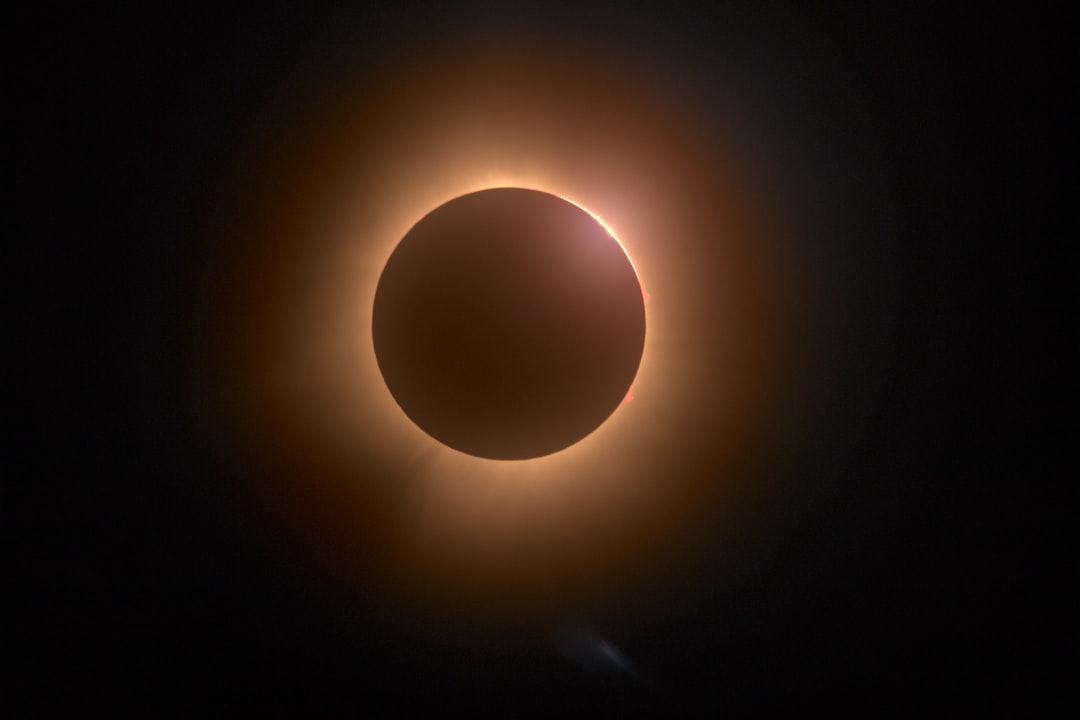
Eclipses are fascinating celestial events that occur when one astronomical body moves into the shadow of another. The geometry of an eclipse involves the intricate alignment of the Sun, Earth, and Moon, which must occur in a specific configuration for an eclipse to take place. This alignment is not a common occurrence; it requires precise positioning and timing.
The three bodies must be in a straight line, with the Moon positioned between the Earth and the Sun for a solar eclipse, or the Earth positioned between the Sun and the Moon for a lunar eclipse. The angular size of these celestial bodies and their distances from one another play crucial roles in determining the type and visibility of the eclipse. The geometry of eclipses can be further understood through the concepts of umbra, penumbra, and antumbra.
The umbra is the darkest part of the shadow where a total eclipse occurs, while the penumbra is the lighter outer part of the shadow where a partial eclipse can be observed. The antumbra is a region where an annular eclipse can be seen, characterized by a ring-like appearance of the Sun around the Moon. The interplay of these shadow regions creates a variety of eclipse experiences for observers on Earth, making each event unique and captivating.
Key Takeaways
- Eclipses occur due to the precise alignment of the Sun, Earth, and Moon, creating solar or lunar eclipses.
- The path of totality is the narrow track on Earth where a total solar eclipse is visible.
- Accurate eclipse predictions rely on understanding celestial mechanics and orbital geometry.
- Eclipses have played important roles in history, mythology, and cultural beliefs worldwide.
- Safe observation and photography of eclipses require special techniques and protective equipment.
The Role of the Sun, Earth, and Moon in Eclipses
The Sun, Earth, and Moon each play vital roles in the occurrence of eclipses. The Sun, as the primary source of light and energy for our solar system, provides the illumination necessary for an eclipse to be visible. Its immense gravitational pull keeps the planets, including Earth, in orbit.
The Moon, on the other hand, is Earth’s natural satellite and has a significant influence on our planet’s tides due to its gravitational force. When the Moon passes between the Earth and the Sun, it blocks some or all of the Sun’s light, resulting in a solar eclipse. Earth’s position is equally important in this celestial dance.
As it orbits the Sun, it also rotates on its axis, creating day and night. During a lunar eclipse, when Earth comes directly between the Sun and the Moon, it casts a shadow on the Moon’s surface. This phenomenon highlights how interconnected these three celestial bodies are; their movements and positions relative to one another dictate when and how eclipses occur.
Types of Eclipses: Solar and Lunar

Eclipses can be broadly categorized into two main types: solar eclipses and lunar eclipses. A solar eclipse occurs when the Moon passes directly between the Earth and the Sun, blocking sunlight either partially or completely. There are three subtypes of solar eclipses: total, partial, and annular.
A total solar eclipse happens when the Moon completely covers the Sun, casting a shadow on Earth and allowing observers in the path of totality to experience a brief moment of darkness during daytime. A partial solar eclipse occurs when only a portion of the Sun is obscured by the Moon, while an annular solar eclipse happens when the Moon is too far from Earth to completely cover the Sun, resulting in a ring-like appearance. Lunar eclipses, in contrast, occur when Earth passes between the Sun and the Moon, causing Earth’s shadow to fall on the Moon.
There are also three types of lunar eclipses: total, partial, and penumbral. A total lunar eclipse occurs when the entire Moon enters Earth’s umbra, resulting in a dramatic change in color as it takes on a reddish hue—often referred to as a “blood moon.” A partial lunar eclipse happens when only a part of the Moon enters Earth’s shadow, while a penumbral lunar eclipse is more subtle, with only a slight shading visible on the Moon’s surface. Each type of eclipse offers unique viewing experiences and scientific opportunities.
The Path of Totality: How Eclipses Move Across the Earth
The path of totality is a term used to describe the narrow strip on Earth’s surface where observers can experience a total solar eclipse. This path varies with each eclipse due to the relative positions and movements of the Sun, Earth, and Moon. Typically only about 100 to 160 kilometers wide, this path can stretch thousands of kilometers across different regions of Earth as it moves from west to east during an eclipse event.
Observers outside this path may witness only a partial solar eclipse or none at all. The movement of this path is influenced by several factors, including the tilt of Earth’s axis and its orbital dynamics around the Sun. As Earth rotates on its axis while simultaneously orbiting the Sun, different locations come into alignment with the Moon’s shadow at different times.
This dynamic nature means that total solar eclipses are relatively rare occurrences for any given location; they may only happen once every few decades or even centuries in some areas. Understanding this path is crucial for astronomers and enthusiasts alike who wish to experience these awe-inspiring events firsthand.
The Perfect Alignment: How the Sun, Earth, and Moon Align During an Eclipse
| Metric | Description | Typical Value | Unit |
|---|---|---|---|
| Angular Diameter of Sun | Apparent size of the Sun as seen from Earth during eclipse | 31.6 – 32.7 | arcminutes |
| Angular Diameter of Moon | Apparent size of the Moon as seen from Earth during eclipse | 29.3 – 34.1 | arcminutes |
| Alignment Precision | Degree of perfect alignment between Sun, Moon, and Earth | 0.01 | arcseconds |
| Distance Earth-Moon | Distance between Earth and Moon during eclipse | 356,500 – 406,700 | km |
| Distance Earth-Sun | Distance between Earth and Sun during eclipse | 147,100,000 – 152,100,000 | km |
| Duration of Totality | Maximum time the Sun is completely covered | up to 7.5 | minutes |
| Shadow Cone Angle | Angle of the Moon’s umbra cone during perfect alignment | ~0.5 | degrees |
The perfect alignment required for an eclipse is not merely a matter of chance; it involves complex celestial mechanics that govern their movements. The orbits of both Earth around the Sun and the Moon around Earth are elliptical rather than perfectly circular. This means that there are times when the distances between these bodies vary significantly.
For instance, when the Moon is at its apogee—the farthest point from Earth—it appears smaller in size compared to when it is at perigee—the closest point—making total solar eclipses less likely during apogee. Moreover, the inclination of the Moon’s orbit relative to Earth’s orbital plane adds another layer of complexity. The Moon’s orbit is tilted at about 5 degrees to Earth’s orbit around the Sun.
As a result, most new moons do not result in solar eclipses because they occur above or below Earth’s shadow plane. Only during specific times known as eclipse seasons—when these orbital planes intersect—can eclipses occur. This intricate dance between celestial bodies highlights not only their beauty but also their precision in alignment during these extraordinary events.
The Science Behind Eclipse Predictions
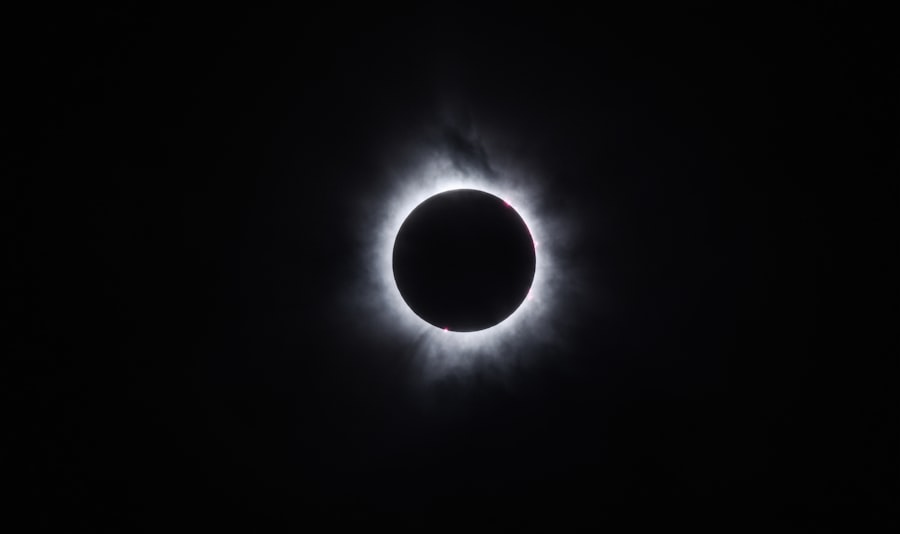
Predicting eclipses involves advanced astronomical calculations that take into account various factors such as orbital mechanics, gravitational influences, and historical data from past eclipses. Astronomers utilize mathematical models to determine when and where eclipses will occur based on established patterns observed over centuries. These predictions can be made with remarkable accuracy; modern technology allows scientists to forecast eclipses many years into the future.
The Saros cycle is one such method used for predicting eclipses. This cycle lasts approximately 18 years and 11 days and involves a series of eclipses that share similar geometry. By tracking these cycles over time, astronomers can identify patterns that help them predict future eclipses with confidence.
Additionally, advancements in technology have enabled more precise measurements of celestial bodies’ positions, further enhancing prediction accuracy. As a result, enthusiasts can plan their observations well in advance to witness these spectacular events.
Historical Significance of Eclipses
Throughout history, eclipses have held significant cultural and scientific importance across various civilizations. Ancient societies often viewed eclipses as omens or messages from deities due to their dramatic nature and unpredictability. For instance, during ancient Mesopotamian times, astronomers meticulously recorded lunar eclipses to predict future occurrences and interpret their meanings within their cultural context.
Similarly, ancient Chinese astronomers recognized solar eclipses as critical events that could signal changes in leadership or dynastic shifts. In addition to their cultural significance, eclipses have also played pivotal roles in advancing scientific understanding. The total solar eclipse of 1919 provided crucial evidence supporting Albert Einstein’s theory of general relativity by demonstrating how light bends around massive objects like the Sun.
Such moments have not only shaped scientific discourse but have also inspired generations of astronomers and scientists to explore further into our universe’s mysteries.
How Eclipses Have Shaped Mythology and Culture
Eclipses have long been woven into the fabric of mythology and culture across different societies worldwide. Many cultures have created rich narratives surrounding these celestial events, often attributing them to divine intervention or cosmic battles between gods. For example, in Norse mythology, an eclipse was believed to occur when wolves chased and devoured Sol (the Sun) or Mani (the Moon).
Similarly, ancient Greeks viewed eclipses as signs from gods warning them about impending doom or significant changes. In more contemporary contexts, eclipses continue to inspire art, literature, and popular culture. They serve as metaphors for transformation or moments of revelation in storytelling across various mediums—from literature to film.
Festivals celebrating eclipses have emerged in many cultures as opportunities for communal gatherings where people come together to witness these awe-inspiring events while sharing stories passed down through generations.
Observing Eclipses Safely
While witnessing an eclipse can be an exhilarating experience, it is crucial to prioritize safety during observation—especially during solar eclipses where direct sunlight can cause severe eye damage if viewed without proper protection. Special eclipse glasses that meet international safety standards are essential for viewing solar eclipses safely; regular sunglasses do not provide adequate protection against harmful rays.
However, using binoculars or telescopes equipped with appropriate filters can enhance visibility and detail during these events. Educating oneself about safe viewing practices ensures that everyone can enjoy these celestial spectacles without compromising their health.
Photographing Eclipses: Tips and Techniques
Capturing an eclipse through photography requires careful planning and technique to ensure stunning results that reflect its beauty accurately. For solar eclipses, using specialized solar filters is essential to protect both camera equipment and eyes while allowing for clear images of this extraordinary event. Photographers should also consider using tripods for stability during long exposures or bracketed shots that capture varying light conditions throughout different phases of an eclipse.
Timing is critical when photographing eclipses; understanding how long each phase lasts allows photographers to prepare adequately for capturing key moments such as totality during a solar eclipse or unique color changes during a lunar eclipse. Additionally, experimenting with different compositions—such as including foreground elements like landscapes or silhouettes—can add depth and context to images captured during these celestial events.
The Future of Eclipse Research and Exploration
As technology continues to advance rapidly, so too does our understanding of eclipses and their implications for science and exploration. Future research endeavors aim not only at improving prediction accuracy but also at utilizing eclipses as opportunities for studying various astronomical phenomena such as solar corona dynamics during total solar eclipses or lunar surface composition during lunar events. Moreover, international collaborations among scientists from different countries are becoming increasingly common as they work together on ambitious projects aimed at exploring our universe further through observational campaigns tied to upcoming eclipses.
These efforts promise exciting discoveries that could deepen humanity’s understanding of celestial mechanics while inspiring future generations to look up at the night sky with wonder. In conclusion, eclipses represent one of nature’s most awe-inspiring phenomena—a testament to the intricate dance between celestial bodies that has captivated humanity throughout history. From their geometric intricacies to their cultural significance across civilizations worldwide, these events continue to inspire curiosity and exploration within both scientific communities and everyday observers alike.
Eclipse geometry and the perfect alignment of celestial bodies are fascinating topics that have intrigued astronomers for centuries. For a deeper understanding of these phenomena, you can explore a related article that delves into the intricacies of celestial alignments and their implications. Check it out here: Eclipse Geometry and Perfect Alignment.
FAQs
What is meant by perfect alignment in eclipse geometry?
Perfect alignment in eclipse geometry refers to the precise positioning of the Sun, Moon, and Earth along a straight line, allowing one celestial body to completely or partially cover another as seen from a specific vantage point.
How does perfect alignment affect the type of eclipse observed?
The degree of alignment determines the type of eclipse: a total eclipse occurs when the alignment is exact, causing complete coverage; a partial eclipse happens with slight misalignment; and an annular eclipse occurs when the Moon is too far from Earth to cover the Sun completely despite alignment.
What are the key geometric factors involved in eclipse alignment?
Key factors include the relative distances between the Sun, Moon, and Earth, their sizes, and their positions along the orbital planes, which must intersect at the nodes for an eclipse to occur.
Why do eclipses not happen every month despite the Moon orbiting Earth monthly?
Eclipses are rare because the Moon’s orbit is tilted about 5 degrees relative to Earth’s orbit around the Sun, so perfect alignment only occurs when the Moon is near the orbital nodes during a new or full moon.
Can perfect alignment be predicted accurately?
Yes, astronomers use precise calculations of celestial mechanics to predict the timing and path of eclipses with high accuracy, often years or decades in advance.
What is the difference between syzygy and perfect alignment?
Syzygy refers to the general alignment of three celestial bodies in a straight line, which includes but is not limited to eclipses; perfect alignment specifically describes the exact positioning required for an eclipse to occur.
How does the geometry of an eclipse influence its duration?
The duration depends on the relative speeds and distances of the bodies involved and the exactness of the alignment; a more precise alignment and slower relative motion result in longer eclipse durations.
What role do the nodes of the Moon’s orbit play in eclipse geometry?
The nodes are the points where the Moon’s orbit crosses the Earth’s orbital plane; eclipses can only occur when the Moon is near these nodes during new or full moon phases, enabling the necessary alignment.