
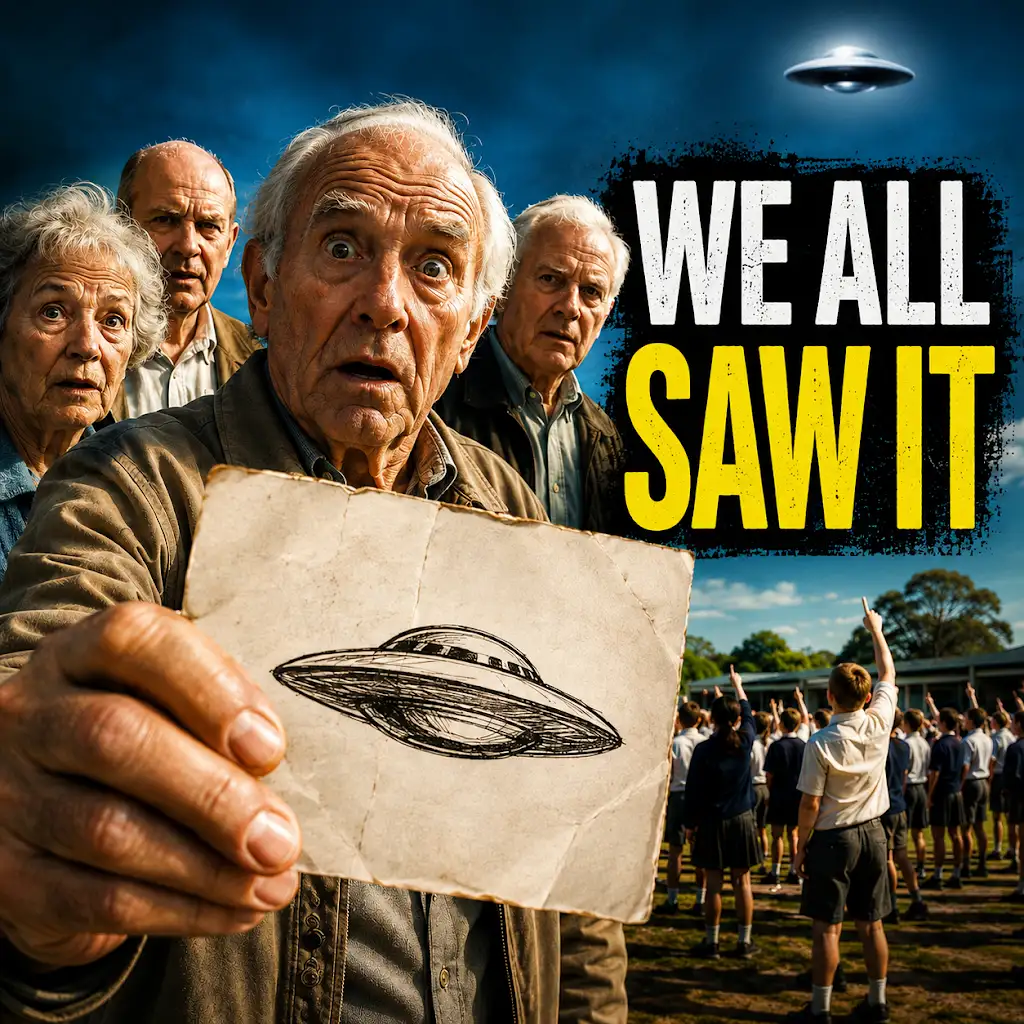
The Westall UFO Incident, which occurred on April 6, 1966, in the Melbourne suburb of Westall, remains one of Australia’s most persistent and debated paranormal mysteries. On that clear Wednesday afternoon, an estimated 200 students from Westall High School, along with several teachers, reported witnessing a large, metallic, disc-shaped object hovering over a paddock adjacent to the school. The event, which lasted approximately 20 minutes, is characterized by a series of dramatic events: the craft allegedly descended, hovered, then ascended rapidly, leaving behind scorched earth and a trail of confusion and wonder. While the popular narrative leans heavily towards extraterrestrial visitation, a thorough, skeptical examination of the available evidence and witness testimony reveals a far more grounded, albeit still intriguing, explanation.
Recounting the Eyewitness Accounts: A Tapestry of Perception
The core of the Westall UFO Incident lies in the overwhelming number of witnesses, primarily schoolchildren, who reported seeing an unidentified flying object. These accounts, gathered in the immediate aftermath and over subsequent years, paint a consistent picture of a silver, disc-shaped craft. Many described it as having a smooth, metallic surface, devoid of any visible seams or markings. Some reported seeing lights or portals on its underside, while others noted its silent, effortless movement.
The Power of Suggestion and Collective Memory
It is crucial to acknowledge the powerful influence of suggestion and collective memory, especially when dealing with a large group of witnesses, many of whom were children. In the post-World War II era, and particularly during the 1960s, popular culture was rife with depictions of flying saucers and aliens. The concept of UFOs was not only present but often sensationalized in newspapers, magazines, and emerging television programming. This pervasive cultural backdrop could have, consciously or unconsciously, shaped the perceptions of the young students.
When a few individuals report seeing something unusual, especially in a group setting, others may be inclined to interpret ambiguous stimuli in a similar vein. The initial reports, likely amplified by peer discussion and the excitement of the event, could have created a shared narrative that was then reinforced by subsequent retellings. The absence of readily available, concrete evidence beyond eyewitness testimony makes it difficult to disentangle genuine perception from shared imagination.
Age and Observational Acuity
The majority of witnesses were school children, aged between 11 and 16. While children are not inherently less observant than adults, their observational acuity can be influenced by a number of factors. Their attention spans may be shorter, and their ability to critically assess unfamiliar phenomena might be less developed. Furthermore, the emotional impact of witnessing something perceived as extraordinary could have led to heightened suggestibility and a tendency to embellish details.
It is also worth noting that memory is a reconstructive process, prone to distortions and additions over time. The passage of decades since the 1966 incident means that accounts have been filtered through years of retelling, media coverage, and potentially, a desire to be part of a compelling story. This is not to suggest malicious intent on the part of the witnesses, but rather to highlight the inherent unreliability of human memory, particularly for extraordinary events.
The Westall UFO incident, which occurred in 1966 in Melbourne, Australia, has long been a topic of intrigue and speculation. While many witnesses describe a mysterious flying object, skeptics have proposed various explanations, including the possibility that the sighting was merely a weather balloon or a misidentified aircraft. For a deeper exploration of these skeptical viewpoints and other related phenomena, you can read more in this article: XFile Findings.
Analyzing the Physical Evidence: The Elusive “Scorched Earth”
One of the most compelling pieces of evidence cited in support of the Westall UFO Incident is the claim of “scorched earth” or unusually flattened grass in the area where the object was reported to have landed or hovered. This physical trace was observed by some students and adults in the aftermath of the event.
Aerial Phenomena and Atmospheric Conditions
While the idea of scorched earth conjures images of intense heat or propulsion, a more mundane explanation might be found in the interaction of a large, low-flying object with the ground under specific atmospheric conditions. Even a large, non-vehicular object moving at low altitude could displace air and vegetation. Furthermore, if the object was metallic and reflecting sunlight, it could have created localized heat effects, particularly if it remained stationary for a period.
However, the term “scorched” is subjective. It’s possible that the ground was simply flattened or disturbed by the displacement of air, or perhaps by the object’s weight if it indeed touched down. The lack of definitive scientific analysis of the “scorched” area at the time means that its exact nature remains open to interpretation. Without samples or detailed scientific documentation, it is difficult to definitively attribute any physical changes to an anomalous object.
The Possibility of Natural Phenomena or Human Intervention
It is also plausible that the “scorched earth” phenomenon was caused by something entirely natural or by human intervention. Perhaps a small, localized fire occurred in the paddock prior to or during the event, and the commotion surrounding the “UFO” distracted from its true cause. Alternatively, the area might have been used for agricultural purposes where such disturbances are not uncommon. The passage of time and the lack of detailed contemporaneous investigation make it challenging to rule out these possibilities.
Exploring Alternative Explanations: The Conventional Culprits
While the extraterrestrial hypothesis remains the most popular explanation for the Westall Incident, a skeptical approach necessitates exploring conventional explanations for the observed phenomena.
Atmospheric Optics and Weather Balloons
One of the most commonly proposed conventional explanations for UFO sightings is the misidentification of atmospheric phenomena or man-made objects. In the case of Westall, the possibility of unusual cloud formations, lenticular clouds, or even the reflection of sunlight off unusual surfaces cannot be entirely dismissed.
However, the descriptions of a solid, metallic, disc-shaped object with controlled movement make simple atmospheric optical illusions less likely. Weather balloons, while capable of hovering and drifting, typically have a more amorphous or clearly defined balloon-like structure, and their movement is dictated by wind currents, not the controlled, rapid ascent described. Nevertheless, without a clear photograph or definitive identification of what was seen, misidentification remains a strong contender.
Military Aircraft and Experimental Technology
The 1960s was a period of significant advancements in military aviation and aerospace technology. It is not inconceivable that a military aircraft, possibly experimental or engaged in classified operations, could have been the source of the sighting. Such aircraft might have unusual shapes, emit lights, and operate with a degree of maneuverability that would appear anomalous to civilian observers.
The fact that the area was relatively undeveloped and close to a school could have made it a suitable location for clandestine testing or observation without attracting widespread public attention. The rapid ascent and disappearance could be consistent with the capabilities of advanced aircraft of the era. However, without any official acknowledgment or declassification of relevant military activities in the region at that time, this remains speculative.
The Role of Media and Public Perception: Crafting the Narrative
The Westall UFO Incident has been extensively documented and sensationalized by the media over the decades. This continuous public discourse has played a significant role in shaping how the event is perceived and remembered.
Sensationalism and the “Greatest UFO Sighting”
From the initial newspaper reports to documentaries and books, the Westall Incident has often been presented as one of the most credible and significant UFO encounters in Australian history. This constant reinforcement of the extraordinary narrative can solidify the belief in a paranormal explanation and overshadow more mundane possibilities.
The media’s role in highlighting the most dramatic elements of the testimonies, such as the rapid ascent, the scorched earth, and the perceived secrecy of authorities (who are often alleged to have covered up the truth), contributes to the enduring mystique of the event. The emphasis on sensationalism can lead to a biased understanding of the evidence.
The Cult of the UFO Enthusiast
The Westall Incident has become a cornerstone for UFO enthusiasts and paranormal investigators. Within these communities, the event is often treated as irrefutable proof of extraterrestrial visitation, and any attempts at skeptical explanation are frequently dismissed as attempts to suppress the truth. This echo chamber effect can further entrench existing beliefs and make it difficult for alternative, more rational explanations to gain traction.
The Westall UFO incident has long fascinated both enthusiasts and skeptics alike, with various explanations proposed over the years. One such skeptical perspective can be found in a related article that discusses how the phenomenon might have been a misidentified aircraft or a weather balloon. This analysis provides a grounded approach to understanding the event, challenging the more sensational theories that have emerged. For further insights into this topic, you can read more in this detailed article that explores the various explanations surrounding the Westall UFO sighting.
Conclusion: Towards a Rational Understanding
The Westall UFO Incident, while captivating and shrouded in mystery, can be approached with a healthy dose of skepticism. The overwhelming reliance on eyewitness testimony, particularly from children, coupled with the passage of time and the inherent fallibility of memory, suggests that a definitive, extraterrestrial explanation may be premature.
The possibility of misidentification of conventional aircraft, atmospheric phenomena, or even a combination of factors cannot be discounted. The narrative has been shaped and amplified by decades of media attention and the passionate advocacy of UFO enthusiasts. Without concrete, verifiable physical evidence that withstands rigorous scientific scrutiny, the Westall Incident remains firmly within the realm of unexplained phenomena, but not necessarily paranormal ones.
A skeptical approach encourages us to look for the most parsimonious explanation, the one that requires the fewest extraordinary assumptions. In the case of Westall, these explanations, while perhaps less sensational, are far more grounded in the observable realities of human perception, atmospheric conditions, and technological capabilities of the time. The Westall UFO Incident, therefore, serves as a fascinating case study not only of potential aerial anomalies but also of the powerful interplay between observation, memory, and the enduring human fascination with the unknown.
200 Students Saw a UFO. Then They Were Told to Stay Silent.
FAQs

What is the Westall UFO incident?
The Westall UFO incident refers to an event that occurred on April 6, 1966, in Melbourne, Australia, where more than 200 students and teachers at two schools reported seeing a UFO in the sky.
What is the skeptical explanation for the Westall UFO incident?
The skeptical explanation for the Westall UFO incident suggests that the sighting was likely a misidentification of natural phenomena, such as a weather balloon, or a combination of mass hysteria and a high-altitude research balloon.
What evidence supports the skeptical explanation?
Support for the skeptical explanation comes from the lack of physical evidence, such as radar data or debris, to support the presence of an extraterrestrial craft. Additionally, the lack of credible eyewitness testimony from independent sources adds to the skepticism.
Are there any alternative theories to explain the Westall UFO incident?
Some alternative theories propose that the UFO sighting was a result of a secret military aircraft or experimental technology being tested in the area. However, there is no concrete evidence to support these claims.
What is the current consensus on the Westall UFO incident?
The current consensus among skeptics and researchers is that the Westall UFO incident was likely a case of misidentification or mass hysteria, and there is no compelling evidence to support the presence of extraterrestrial activity.