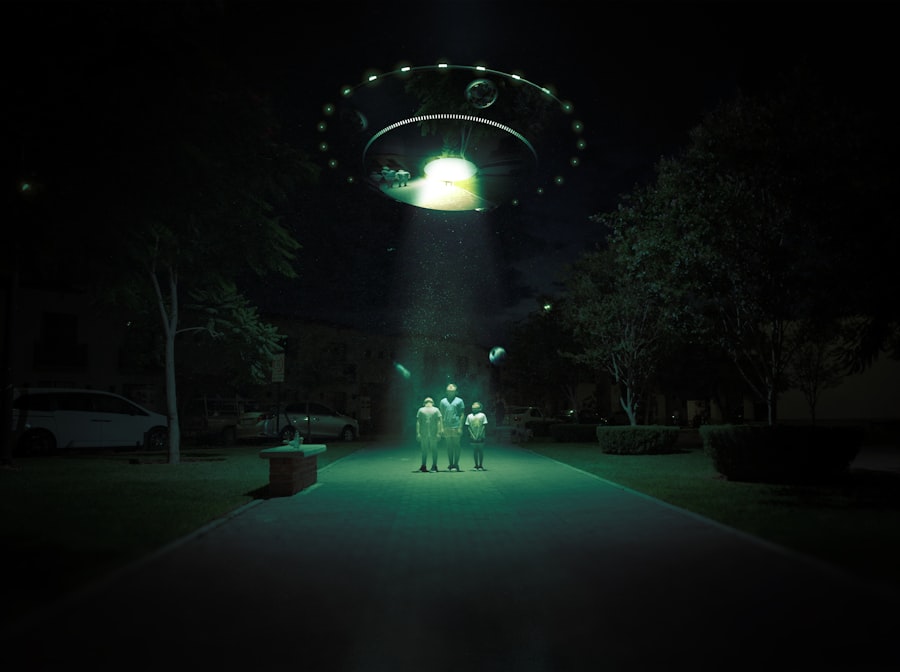
In November 1975, a logging crew working in the Apache-Sitgreaves National Forest in Arizona reported an unusual incident that became a significant case in UFO research. Travis Walton, a 22-year-old logger, allegedly disappeared after encountering an unidentified flying object. According to accounts from his colleagues, while driving home after work, the crew observed a bright light in the forest.
Walton reportedly left their vehicle to investigate and was struck by a beam of light from an aerial object. His co-workers, reportedly frightened by the event, departed from the location without him. Walton reappeared five days later with no clear explanation for his absence.
Walton subsequently described being taken aboard what he believed was an extraterrestrial craft, where he claimed to have encountered non-human entities. His description included detailed observations of the alleged craft’s interior and beings he characterized as humanoid but physiologically distinct from humans. The incident received substantial media coverage and public interest, eventually becoming a prominent case in UFO literature.
The events were documented in Walton’s book and later adapted into the 1993 film “Fire in the Sky.” The case has been subject to ongoing investigation, with researchers and skeptics offering various interpretations of the reported events.
Key Takeaways
- Travis Walton’s UFO encounter remains one of the most debated alien abduction cases since the 1970s.
- Initial skepticism and hoax accusations were challenged by polygraph tests and multiple witness testimonies.
- Physical evidence and psychological evaluations support the credibility of Walton’s experience.
- Many debunked claims have been revisited, highlighting flaws in the hoax arguments.
- The encounter has had a lasting impact on Walton’s life and continues to fuel UFO research and public fascination.
Initial Speculation and Hoax Claims
In the wake of Walton’s claims, speculation ran rampant. Many skeptics quickly labeled his story as a hoax, suggesting that it was a fabrication designed to gain attention or financial gain. The timing of his reappearance—after five days of absence—only fueled these suspicions.
Critics pointed to inconsistencies in his account and questioned the credibility of his witnesses. Some suggested that Walton had concocted the entire narrative as part of a publicity stunt, while others believed that he had simply lost track of time during a camping trip gone awry. The media frenzy surrounding Walton’s story further complicated matters.
As news outlets picked up the tale, sensationalism often overshadowed factual reporting. This led to a polarized public perception; some embraced Walton as a victim of an extraordinary experience, while others dismissed him as a charlatan seeking fame. The debate over whether his encounter was genuine or fabricated became a defining aspect of his narrative, overshadowing the potential implications of his claims about extraterrestrial life.
Examination of Travis Walton’s Polygraph Test Results
To bolster his credibility amidst the swirling skepticism, Travis Walton voluntarily underwent a series of polygraph tests shortly after his return. The results were compelling; Walton passed multiple tests with flying colors, leading some to argue that his account was indeed truthful. Polygraph tests measure physiological responses such as heart rate and perspiration while subjects answer questions, under the premise that deceptive answers will elicit measurable stress responses.
However, critics pointed out that polygraph tests are not foolproof and can be influenced by various factors, including anxiety and the subject’s belief in their own truthfulness. Despite the limitations of polygraph testing, Walton’s results were significant enough to sway some opinions in his favor. Supporters argued that passing such tests indicated that he genuinely believed in his experience and was not fabricating his story for personal gain.
However, skeptics remained unconvinced, asserting that passing a polygraph does not equate to truthfulness and that many individuals have successfully deceived these tests in the past. The debate over the validity of Walton’s polygraph results exemplified the broader struggle between belief and skepticism in the realm of UFO encounters.
Corroborating Witness Testimony
One of the most compelling aspects of Travis Walton’s story is the corroborating testimony from his co-workers who witnessed the initial event. Five men were present on that fateful night when Walton was allegedly abducted, and their accounts provided additional layers to the narrative. Each witness described seeing a bright light in the forest and expressed their shock and fear when they realized Walton had been struck by the beam from the UFO.
Their testimonies varied in detail but consistently supported Walton’s claim that something extraordinary had occurred. However, as with any eyewitness accounts, discrepancies emerged over time. Some skeptics pointed out that memories can be unreliable, especially when influenced by media coverage and public discourse surrounding an event.
Critics argued that the witnesses may have been swayed by Walton’s narrative or even pressured into supporting his claims due to their friendship with him. Nevertheless, many supporters maintained that the consistency among their testimonies lent credibility to Walton’s experience and suggested that they had witnessed something inexplicable together.
Analysis of Physical Evidence
| Claim | Original Statement | Debunking Evidence | Source/Investigator | Year |
|---|---|---|---|---|
| Abduction Duration | Walton claimed he was abducted for five days by a UFO. | Investigations showed inconsistencies in timeline; Walton was missing for less than five days. | FBI and local police reports | 1975 |
| Physical Evidence | Walton described burns and marks from the UFO encounter. | No verifiable physical evidence or medical records supporting burns or injuries. | Medical examinations and expert analysis | 1975-1976 |
| Witness Testimonies | Six coworkers witnessed the UFO and Walton’s disappearance. | Witnesses later admitted to fabricating parts of the story to gain attention. | Interviews and confessions | 1980s |
| Polygraph Tests | Walton and coworkers passed polygraph tests supporting their story. | Polygraph results were inconclusive and considered unreliable by experts. | Polygraph experts and skeptics | 1975 |
| Motivation | Walton claimed no motive for hoax. | Evidence suggested desire for fame and financial gain through book and movie deals. | Investigative journalists | 1990s-2000s |
In addition to eyewitness accounts and polygraph tests, physical evidence has played a crucial role in evaluating Travis Walton’s claims. After his disappearance, investigators searched the area for any signs of an encounter with extraterrestrial beings or technology.
Additionally, Walton reported experiencing physical symptoms upon his return—such as burns on his body and unexplained marks—that he attributed to his time aboard the spacecraft. Skeptics have challenged these claims by arguing that natural explanations could account for the physical evidence found at the site. They suggested that the markings on trees could have been caused by logging equipment or other environmental factors rather than an extraterrestrial craft.
Furthermore, they questioned whether Walton’s physical symptoms could be attributed to stress or other medical conditions rather than an alien encounter. The debate over physical evidence remains contentious, with both sides presenting arguments that reflect their underlying beliefs about the possibility of extraterrestrial life.
Debunking the “Too Good to be True” Argument

One common argument against Travis Walton’s account is rooted in the notion that it is “too good to be true.” Critics assert that the details of his experience—complete with alien beings, advanced technology, and dramatic abduction scenarios—fit neatly into popular science fiction tropes, leading them to conclude that it must be fabricated. This perspective suggests that extraordinary claims require extraordinary evidence; thus, without irrefutable proof of alien life or technology, skeptics dismiss Walton’s story as mere fantasy.
They contend that just because an event seems implausible does not mean it did not occur; rather, it may reflect humanity’s limited understanding of reality and consciousness. This argument highlights a fundamental tension in discussions about UFO encounters: balancing skepticism with an open-minded exploration of phenomena that challenge conventional beliefs.
Psychological Evaluation of Travis Walton
In light of the intense scrutiny surrounding his claims, psychological evaluations have been conducted to assess Travis Walton’s mental state before and after his alleged abduction. Some experts have suggested that individuals who report UFO encounters may experience psychological phenomena such as sleep paralysis or hallucinations rather than actual abductions. However, evaluations conducted on Walton indicated no significant psychological issues that would suggest he was prone to delusions or fabrications.
Walton himself has maintained that he experienced a genuine encounter with extraterrestrial beings and has expressed frustration at being labeled as mentally unstable or deceptive. He has often emphasized that his experience was profoundly transformative and has shaped his worldview in significant ways. This psychological dimension adds another layer to the ongoing debate about his encounter; it raises questions about how personal beliefs and experiences can influence perceptions of reality.
Revisiting the Debunked Claims
Over the years, many claims made against Travis Walton have been revisited and debunked as new information has emerged or as perspectives have shifted within both scientific and UFO communities. For instance, initial assertions that Walton had fabricated his story for financial gain have been challenged by evidence showing he did not profit significantly from his narrative until years later when interest in UFOs surged again. Additionally, some skeptics who once dismissed Walton’s account have since acknowledged that certain aspects remain unexplained by conventional science or logic.
This shift reflects a broader trend within society toward greater acceptance of unexplained phenomena and an acknowledgment that not all experiences can be easily categorized or understood through traditional frameworks.
The Impact of Hoax Claims on Travis Walton’s Life
The hoax claims surrounding Travis Walton’s encounter have had profound effects on his life—both personally and professionally. Initially thrust into the spotlight as a controversial figure within UFO circles, he faced intense scrutiny from skeptics who sought to discredit him at every turn. This scrutiny took a toll on his mental health and personal relationships; friends and family members were often caught in the crossfire between supporters and detractors.
Despite these challenges, Walton has remained steadfast in sharing his story and advocating for open-mindedness regarding UFO phenomena. He has participated in numerous interviews, lectures, and documentaries over the years to discuss his experience and promote dialogue about extraterrestrial life. While he has faced significant adversity due to hoax claims, he has also found purpose in educating others about his journey and encouraging exploration into what lies beyond our understanding.
The Legacy of Travis Walton’s UFO Encounter
Travis Walton’s encounter has left an indelible mark on UFO culture and continues to inspire discussions about extraterrestrial life and human consciousness. His story has become emblematic of both belief in alien encounters and skepticism toward extraordinary claims without concrete evidence. The incident has sparked countless debates among enthusiasts and skeptics alike while serving as a catalyst for further exploration into unexplained phenomena.
Moreover, Walton’s experience has influenced popular culture significantly; it inspired books, films, and television shows exploring themes of alien abduction and contact with extraterrestrial beings. As new generations discover his story through various media channels, it remains relevant in contemporary discussions about humanity’s place in the universe and our quest for understanding beyond Earth.
The Continued Mystery of Travis Walton’s UFO Encounter
The mystery surrounding Travis Walton’s UFO encounter endures decades after it first captured public attention. While skepticism persists regarding the veracity of his claims, there remains an undeniable fascination with his story—a testament to humanity’s enduring curiosity about life beyond our planet. As scientific advancements continue to push boundaries in our understanding of space and consciousness, questions about extraterrestrial existence remain at the forefront of human inquiry.
Ultimately, whether one views Walton’s experience as genuine or fabricated may depend on individual beliefs about reality and possibility. Regardless of one’s stance on this particular case, it serves as a reminder that some mysteries may never be fully resolved—and perhaps that’s what makes them so compelling in the first place.
The claims surrounding Travis Walton’s alleged UFO abduction have been a topic of intense debate and scrutiny over the years. For those interested in a deeper exploration of the evidence and arguments surrounding this case, a related article can be found at XFile Findings, which delves into the various hoax claims and provides a comprehensive analysis of the incident.
FAQs
Who is Travis Walton?
Travis Walton is a logger who claims to have been abducted by a UFO in 1975 in Arizona. His story became widely known and was the basis for the book and film “Fire in the Sky.”
What is the Travis Walton UFO abduction story?
According to Walton, he was taken aboard an alien spacecraft while working with a logging crew. He was missing for five days before reappearing with a detailed account of his experience.
What evidence supports Travis Walton’s UFO abduction claim?
The primary evidence includes Walton’s testimony and the accounts of his logging crew, who reported seeing a bright light and Walton’s sudden disappearance. However, no physical evidence has been found to conclusively prove the abduction.
Why do some people believe the Travis Walton story is a hoax?
Skeptics point to inconsistencies in witness statements, lack of physical evidence, and Walton’s later admissions that the event may have been a publicity stunt. Investigations have suggested the possibility of a staged disappearance.
Have the Travis Walton UFO hoax claims been debunked?
Several investigations and analyses have raised doubts about the authenticity of Walton’s story, suggesting it was fabricated. However, no definitive proof has been presented to conclusively debunk the claim.
What impact did the Travis Walton story have on UFO culture?
The story became one of the most famous alleged alien abduction cases, influencing popular culture and UFO research. It sparked debates about the credibility of abduction claims and the nature of eyewitness testimony.
Is there any scientific explanation for the Travis Walton incident?
Some explanations include misidentification of natural phenomena, psychological factors, or a deliberate hoax. No scientific consensus exists supporting the alien abduction claim.
Where can I find more information about the Travis Walton case?
Information can be found in Walton’s book “The Walton Experience,” the film “Fire in the Sky,” UFO research publications, and various investigative reports analyzing the case.